Blue-Eyed Grass: A Delicate and Charming Wildflower

ist-pasion.com – Blue-Eyed Grass, scientifically known as Sisyrinchium angustifolium, is a charming and delicate wildflower that adds a touch of elegance and softness to any landscape. Despite its name, this plant is not actually a true grass but a member of the iris family, and its stunning, star-shaped blue flowers are a wonderful sight in gardens, meadows, and wildflower patches. With its low-growing habit, vibrant color, and ease of care, Blue-Eyed Grass has become a beloved addition to both wild and cultivated gardens across North America.

Appearance and Characteristics

Blue-Eyed Grass is a perennial herb that typically grows in a clumping form, reaching heights of 6 to 12 inches (15 to 30 cm). The plant features slender, grass-like leaves that form a base rosette, with long, narrow blades that resemble those of ornamental grasses. The flowers, which bloom in late spring to early summer, are the real highlight of the plant.

The flowers are small, usually about 1 to 2 inches (2.5 to 5 cm) in diameter, and are star-shaped with six petal-like tepals. They range in color from a soft lavender-blue to a vibrant, deep blue with a contrasting yellow center, creating a beautiful “eye” in the middle of each bloom. These flowers appear in clusters atop slender stems that rise above the foliage, creating a delicate and airy display. Each plant typically produces several flowers over the course of its blooming period, making for a lovely, natural-looking flower bed.

Blue-Eyed Grass has a relatively short blooming period, lasting a few weeks, but its bright, cheerful appearance is well worth the wait. After the flowers fade, the plant’s long, grassy foliage continues to provide texture and interest in the garden.

Growing Conditions and Care

Blue-Eyed Grass is a hardy and adaptable plant that thrives in a wide range of conditions. It grows best in full sun but can tolerate partial shade, though its blooms may be fewer in shadier locations. It is a native plant that is well-suited to prairies, meadows, and grasslands, making it an excellent choice for naturalized areas or wildflower gardens.

This plant prefers well-drained soil, including sandy, loamy, or clay-based soils. It is also tolerant of poor soils, which makes it a perfect option for dry, rocky, or slightly acidic sites. Once established, Blue-Eyed Grass is quite drought-tolerant, but regular watering during dry periods can help promote healthier growth and more abundant blooms.

Blue-Eyed Grass does not require extensive care or maintenance, making it a great plant for gardeners of all levels. It can be grown from seed, division, or nursery-grown plants, and once established, it will spread gradually by self-seeding or by forming small clumps over time. However, it tends to remain relatively compact and non-invasive, so it won’t take over a garden.

To encourage the plant to bloom again in subsequent years, gardeners can deadhead spent flowers and trim back any faded foliage to keep the plant looking neat. Additionally, applying a light mulch around the base of the plant in the fall can help protect the roots during the winter months.

Benefits and Uses

Blue-Eyed Grass is an excellent choice for a variety of garden applications. Its small size and delicate flowers make it ideal for rock gardens, meadow-style plantings, or as part of a mixed border. The plant’s grass-like foliage also works well in ornamental grass gardens, where it adds texture and a soft, natural feel.

This wildflower is a popular choice for naturalized gardens, particularly those focused on native plants. Its ability to thrive in poor soils and its relatively low water needs make it an eco-friendly option for xeriscaping, where water conservation is a priority.

In addition to its ornamental value, Blue-Eyed Grass is a valuable plant for attracting pollinators. The flowers are a favorite of bees, butterflies, and other insects, helping to support local wildlife populations and promoting biodiversity in the garden. The plant’s natural appeal to pollinators also makes it an excellent choice for creating a wildlife-friendly garden.

Symbolism and Cultural Significance

While Blue-Eyed Grass does not have the same deep cultural or symbolic associations as some other flowers, its beauty and delicate nature make it a symbol of purity, simplicity, and the quiet elegance found in wildflowers. Its star-shaped blue flowers evoke a sense of calm and serenity, and it is often seen as a representation of natural beauty.

In the language of flowers, Blue-Eyed Grass could be interpreted as a symbol of humility, as it grows in the wild and often blooms in places where more showy plants might not thrive. Its understated elegance and ability to brighten even the most modest garden areas give it a timeless and humble charm.

Conclusion

Blue-Eyed Grass is a delightful and versatile wildflower that adds a touch of beauty and grace to any garden or natural landscape. With its delicate, star-shaped blue flowers and grassy foliage, it offers texture, color, and interest without being overwhelming. Easy to grow, low-maintenance, and drought-tolerant, Blue-Eyed Grass is an ideal plant for native gardens, wildflower meadows, and naturalized landscapes. Whether used in mixed borders, rock gardens, or as a ground cover, this charming flower is sure to bring a sense of tranquility and natural elegance to any outdoor space.

Angel’s Fishing Rod: The Graceful Arching Beauty

ist-pasion.com – Angel’s Fishing Rod (Dierama pulcherrimum), also known as the Wand Flower, is a captivating perennial known for its graceful, arching stems adorned with bell-shaped flowers. Native to southern Africa, this stunning plant adds a touch of elegance to any garden with its delicate, pendulous blooms that resemble a fishing rod gently bending under the weight of a catch. Its soft, flowing form and long-lasting flowers make it a popular choice for borders, cottage gardens, and water features.

Key Features of the Angel’s Fishing Rod

  1. Elegant, Arching Stems: The most distinctive feature of Angel’s Fishing Rod is its long, arching stems that can grow up to 4-6 feet in height. These thin, wiry stems bend gracefully under the weight of the blooms, creating a weeping, fountain-like effect that adds movement and texture to the garden.
  2. Bell-Shaped Flowers: In late spring to mid-summer, Angel’s Fishing Rod produces clusters of bell-shaped flowers that dangle from the ends of the stems. The flowers range in color from soft pink and mauve to deep purple, with some varieties producing white or red blooms. These delicate, pendulous flowers resemble tiny bells swaying in the breeze, enhancing the plant’s graceful appearance.
  3. Evergreen Foliage: The plant’s narrow, grass-like leaves form a clump of evergreen foliage that remains attractive throughout the year. The leaves provide an excellent backdrop to the flowering stems, adding texture and interest even when the plant is not in bloom.
  4. Long-Lasting Blooms: The flowers of Angel’s Fishing Rod are long-lasting, with each flower spike producing a succession of blooms over several weeks. The flowering period typically lasts from late spring through summer, providing a continuous display of color and elegance in the garden.
  5. Hardy Perennial: Angel’s Fishing Rod is a hardy perennial that thrives in USDA zones 7-10. It is relatively easy to grow in the right conditions, making it a favorite for gardeners who want a low-maintenance plant with a striking appearance.

Growing and Caring for Angel’s Fishing Rod

  • Sunlight: Angel’s Fishing Rod thrives in full sun and needs at least 6 hours of direct sunlight each day to produce the best flowering display. It can tolerate partial shade, but flowering may be reduced.
  • Soil: This plant prefers well-drained, fertile soil. It is tolerant of sandy or loamy soils but does not do well in heavy, waterlogged soils. Adding organic matter or compost to the soil can improve drainage and provide the nutrients the plant needs to thrive.
  • Watering: Angel’s Fishing Rod prefers moist soil but can tolerate dry periods once established. Water regularly during the growing season, especially in dry weather, to ensure healthy growth and abundant flowering. Be careful not to overwater, as the plant does not like soggy soil.
  • Planting: When planting Angel’s Fishing Rod, space the plants about 18 inches apart to allow for their arching stems to spread. The plant looks best when grown in groups or clumps, where its graceful form can create a more dramatic effect.
  • Pruning and Maintenance: After the flowers have finished blooming, cut back the spent flower stems to encourage new growth. The evergreen foliage can be left intact, but if it becomes untidy, you can trim it back in late winter or early spring before new growth begins. Divide the clumps every 3-4 years to maintain plant health and vigor.

Popular Uses of Angel’s Fishing Rod

  1. Borders and Cottage Gardens: Angel’s Fishing Rod is perfect for adding height and movement to garden borders and cottage-style gardens. Its arching stems and delicate flowers provide a soft, romantic feel that complements other perennial plants.
  2. Water Features: The plant’s weeping form and reflection in water make it an excellent choice for planting near ponds, streams, or water features. The graceful arch of the stems adds a calming, tranquil quality to any water garden.
  3. Cut Flowers: Angel’s Fishing Rod makes a beautiful cut flower for floral arrangements. Its long-lasting, bell-shaped blooms add a touch of elegance and charm to bouquets, whether used fresh or dried.
  4. Wildlife-Friendly Gardens: The flowers of Angel’s Fishing Rod attract pollinators such as bees and butterflies, making it a great addition to wildlife-friendly gardens. Its evergreen foliage also provides cover and habitat for small insects and animals.

Varieties of Angel’s Fishing Rod

There are several varieties of Angel’s Fishing Rod, each offering slightly different flower colors and forms:

  1. Dierama pulcherrimum: The most common species, D. pulcherrimum, produces pink to mauve flowers on long, arching stems. It is the largest and most popular variety in gardens.
  2. Dierama igneum: This variety features striking red or deep pink flowers, adding a bold splash of color to the garden.
  3. Dierama dracomontanum: A smaller variety, D. dracomontanum grows to about 3 feet tall and produces delicate white or pale pink flowers. It is ideal for smaller gardens or containers.
  4. Dierama robustum: A more robust variety with larger flowers and thicker stems, D. robustum is perfect for creating a bold statement in the garden with its deep pink to purple flowers.

Conclusion

Angel’s Fishing Rod is a unique and graceful perennial that adds elegance and charm to any garden. With its arching stems, delicate bell-shaped flowers, and evergreen foliage, it creates a sense of movement and beauty, making it a perfect choice for borders, cottage gardens, and water features. Its low-maintenance nature and long-lasting blooms make it a favorite among gardeners who appreciate both form and function in their outdoor spaces. Whether used to soften the edges of a garden or as a focal point near a pond, Angel’s Fishing Rod is a stunning plant that brings a touch of sophistication to any landscape.

Princess Kako of Japan: The Young Royal Embodying Modernity

ist-pasion.com – Princess Kako of Japan, born on December 29, 1994, is the second daughter of Crown Prince Fumihito (Prince Akishino) and Crown Princess Kiko, and the younger sister of Princess Mako. As a member of the Japanese Imperial Family, Princess Kako has grown up within the traditions of one of the world’s oldest and most respected monarchies, yet she has also come to represent the changing landscape of Japan’s monarchy in the modern age. While still relatively young, her role as a royal has already garnered significant attention, both in Japan and internationally.

Early Life and Education

Princess Kako was born at the University of Tokyo Hospital, the second of three children of Crown Prince Fumihito and Crown Princess Kiko. Growing up in the Imperial Family, she experienced both the public duties and private moments that define the lives of royal family members. Like her sister, Princess Mako, Princess Kako attended the prestigious Gakushuin School, a renowned educational institution in Japan. She later continued her studies at Gakushuin University, where she earned a degree in the humanities, with a particular interest in history and international relations.

In addition to her academic pursuits in Japan, Princess Kako has had the opportunity to study abroad. She spent time in the United Kingdom, where she attended the University of Leeds to further her studies. This international experience allowed her to gain a broader perspective on the world and strengthened her abilities to represent Japan in diplomatic and cultural contexts.

Her education reflects a well-rounded, modern approach to preparing for the duties of royal life. It also shows her desire to combine traditional academic values with an understanding of contemporary global affairs, equipping her with the skills to represent Japan’s monarchy in an increasingly interconnected world.

Royal Duties and Public Engagements

As a member of the Imperial Family, Princess Kako has taken part in numerous public duties and royal events. Her engagements range from ceremonial functions to attending state visits and representing the royal family at cultural events, where she upholds the values and traditions of the Japanese monarchy. Princess Kako’s participation in these events has helped to establish her as a gracious and capable representative of the Imperial Family.

While her elder sister, Princess Mako, attracted much media attention due to her marriage to a commoner and her renunciation of royal status, Princess Kako has maintained a quieter public profile. Nevertheless, she has earned respect for her composed demeanor, intelligence, and dedication to her royal duties. She has represented the Imperial Family at key events both in Japan and abroad, particularly focusing on cultural and humanitarian activities.

In addition to her royal duties, Princess Kako has shown a strong interest in issues such as child welfare, education, and cultural heritage. Her work in these areas has helped bridge the traditional aspects of the monarchy with modern concerns, showing her ability to adapt to the changing needs of society while remaining rooted in her royal legacy.

Focus on Traditional and Modern Roles

Princess Kako’s role as a member of the Imperial Family reflects both traditional and modern elements of royal life. While she is expected to adhere to the customs and rituals that define Japan’s monarchy, she has also demonstrated a desire to engage with contemporary issues in society.

In her public appearances, Princess Kako often emphasizes the importance of Japan’s cultural heritage. She has been involved in events celebrating Japan’s traditional arts, including calligraphy, tea ceremonies, and classical music. However, she is also keenly aware of the changing expectations surrounding the monarchy, especially as Japan faces challenges related to its royal succession laws and the increasingly prominent roles women are playing in society.

One of the key aspects of Princess Kako’s public persona is her ability to balance these two elements—respecting tradition while engaging with the evolving role of the Imperial Family in modern Japan. This balance has allowed her to carve out a role that is both reflective of her heritage and aligned with the changing expectations of the public and the monarchy.

The Impact of Female Royals on Japan’s Imperial Family

While Japan’s Imperial Family is primarily male-line hereditary, the role of female royals, including Princess Kako, has become increasingly significant in recent years. With the limited number of male heirs to the Chrysanthemum Throne, discussions about the role of women in the Imperial Family have become more prominent. Princess Kako, along with her mother and older sister, has been part of a growing conversation about gender equality within the monarchy.

Though women are excluded from the line of succession under the current Imperial Household Law, Princess Kako’s contributions to the royal family reflect her importance as a public figure. She represents a modern shift in how women in the royal family can influence Japan’s cultural, social, and political life, even if they do not have a direct role in succession. Princess Kako’s presence in the Imperial Family has highlighted the importance of supporting women in royal roles, showing that their impact can extend beyond the traditional expectations of royal duties.

Personal Life and Future Prospects

Though Princess Kako’s public life has focused on royal engagements, she has kept much of her personal life private. Like many members of the Imperial Family, she has grown up under the scrutiny of the public eye, but she has largely managed to maintain a sense of privacy and normalcy. This is particularly important for a young royal like Princess Kako, who will likely continue to develop her public and private identity as she matures.

As she continues her royal duties and public appearances, it is expected that Princess Kako will take on even more significant roles in representing the Imperial Family. While her future path may not be as heavily scrutinized as that of her older sister, Princess Mako, Princess Kako’s quiet but steadfast dedication to her responsibilities has already positioned her as an influential figure in the future of Japan’s monarchy.

Given the ongoing challenges surrounding Japan’s succession laws and the limited number of male heirs, Princess Kako may one day find herself in a more prominent role within the Imperial Family. Whether or not Japan’s laws are amended to allow women to ascend to the throne, Princess Kako will undoubtedly continue to serve as an important figure in the royal family, maintaining the balance between tradition and modernity.

Conclusion

Princess Kako of Japan represents the future of the Imperial Family—one that honors the rich cultural heritage of the past while engaging with the challenges and opportunities of the present. Through her education, royal duties, and engagement with contemporary issues, she has demonstrated her ability to represent Japan’s monarchy in a way that respects its traditions while also contributing to the modernization of the institution.

As Princess Kako continues to grow into her role, her contributions to Japan’s royal family will likely play a significant part in shaping the monarchy’s future. Her graceful presence and dedication to her responsibilities make her a key figure in the ongoing evolution of the Imperial Family, reflecting the dynamic relationship between tradition, gender, and the changing expectations of modern Japan.

Princess Sayako: The Younger Daughter of Crown Prince Fumihito

ist-pasion.com – Princess Sayako, born on November 18, 1993, is the younger daughter of Crown Prince Fumihito (Prince Akishino) and Crown Princess Kiko, making her the younger sister of Princess Mako and Princess Kako. As a member of Japan’s Imperial Family, Princess Sayako’s life has been marked by both the privileges and challenges that come with royal status. Despite her relatively low public profile compared to her elder siblings, she has played an important role in representing the Imperial Family in both Japan and internationally. Princess Sayako’s journey highlights the balance between tradition and modernity in the monarchy, as well as the evolving expectations of royal women in Japan.

Early Life and Education

Princess Sayako was born at the University of Tokyo Hospital, the youngest of three children of Crown Prince Fumihito and Crown Princess Kiko. She grew up in the Imperial Family, living in the Akasaka Estate in Tokyo, where she was exposed to both royal traditions and the normal experiences of family life. Like her older sisters, Princess Mako and Princess Kako, Princess Sayako was raised with a strong focus on education and royal duties.

Princess Sayako attended the Gakushuin School, a prestigious educational institution for members of the Imperial Family, where she excelled in her studies. She later enrolled at the Gakushuin University, where she pursued a degree in literature. Throughout her school years, Princess Sayako demonstrated a keen interest in literature, culture, and social welfare, subjects that would later influence her public roles as a royal.

In addition to her formal education in Japan, Princess Sayako has shown an openness to engaging with global perspectives. While she has generally maintained a quieter profile in comparison to her siblings, her academic background and intellectual pursuits have paved the way for a meaningful role in royal life.

Role in the Imperial Family

As a member of the Japanese Imperial Family, Princess Sayako has been involved in a wide range of royal duties, both ceremonial and diplomatic. She has attended numerous state functions, official events, and cultural celebrations, where she has represented the Imperial Family with grace and composure. Her contributions to the monarchy have been appreciated, even though she has often maintained a more reserved public presence compared to her older sisters.

Princess Sayako’s role within the family is symbolic of the growing importance of younger members of the royal family in the 21st century, particularly as Japan faces challenges related to its succession laws. With the number of male heirs to the Chrysanthemum Throne dwindling, the role of women within the royal family is increasingly in the spotlight. While Princess Sayako is not in the line of succession due to Japan’s Imperial Household Law, her participation in royal duties remains a key aspect of her responsibilities.

Throughout her public appearances, Princess Sayako has often focused on cultural and charitable causes. She has attended events promoting traditional Japanese arts, such as calligraphy and tea ceremonies, and has been involved in activities that raise awareness about social issues, particularly those related to children and welfare.

The Changing Role of Women in the Imperial Family

The role of women in Japan’s Imperial Family has long been a subject of discussion, particularly given the country’s Imperial Household Law, which limits succession to male heirs. As such, women like Princess Sayako have historically had symbolic roles within the royal family, rather than direct involvement in governance or succession.

While women in the Imperial Family cannot ascend to the throne under the current laws, their presence and engagement in public life are still highly significant. Princess Sayako’s involvement in cultural activities, charity work, and state functions illustrates the evolving role of royal women as influential figures in Japanese society, even if they do not play a direct part in the succession.

Princess Sayako’s quiet but steady presence within the Imperial Family reflects the broader modernization of Japan’s monarchy, as the royal family grapples with questions about gender, succession, and public expectations. Her ability to navigate the challenges of being a modern royal woman while remaining respectful of traditional expectations has made her an important figure in Japan’s royal family.

Personal Life and Future

Though Princess Sayako has generally kept her personal life private, it is clear that she is deeply committed to her royal duties. While much of the public’s attention has focused on her elder sisters, Princess Sayako has shown that she is equally devoted to representing the Imperial Family and carrying out her responsibilities with diligence and grace. She remains an important figure in the monarchy, as both a representative of the Imperial Family and a symbol of the younger generation of royals.

In the future, Princess Sayako will likely continue to serve as a key figure in public life, attending ceremonies, promoting cultural heritage, and supporting charitable causes. Though her role may not have the same public visibility as her elder siblings, her contributions will continue to shape the direction of Japan’s royal family as it faces evolving societal and cultural shifts.

Conclusion

Princess Sayako of Japan embodies the balance between royal tradition and modernity that defines the Japanese Imperial Family in the 21st century. As the younger daughter of Crown Prince Fumihito and Crown Princess Kiko, she has quietly but steadily fulfilled her royal duties, representing Japan with dignity and respect for its cultural heritage. While Japan’s Imperial Household Law limits the role of women in the succession line, Princess Sayako’s involvement in public life remains significant and indicative of the shifting landscape of the monarchy.

Her academic pursuits, cultural engagement, and commitment to social causes reflect a modernizing force within the royal family, even as she upholds its rich traditions. Princess Sayako’s role in the Japanese Imperial Family will undoubtedly continue to evolve, and her legacy will be shaped by her contributions to the monarchy in a rapidly changing world.

Māori Art and Craft: Weaving & Contemporary Creations

ist-pasion.com – Māori art and craft have been central to the cultural expression of the Māori people for centuries. Traditionally, Māori art is deeply intertwined with the spiritual and social aspects of their lives, with carving and weaving serving as important forms of storytelling, identity, and connection to their ancestors. From the intricate wood carvings adorning the wharenui (meeting houses) to the beautifully woven cloaks and baskets, Māori art reflects the deep relationship between the people, their environment, and their heritage. In recent years, contemporary Māori artists have infused new forms and ideas into traditional practices, creating a dynamic blend of old and new. This article explores the rich history of Māori art and craft, examining the significance of carving, weaving, and the evolution of contemporary Māori creations.

The Tradition of Māori Carving

Carving, or tohunga whakairo, is one of the most distinctive and important forms of Māori art. The intricate carvings of Māori are not only decorative but also serve to tell stories, record genealogies, and honor ancestors. Carving is a sacred practice that requires great skill and knowledge, with the artist often being regarded as a tohunga (master craftsman) who has inherited the knowledge of the craft through generations.

The Wharenui and its Carvings

One of the most prominent places where Māori carvings are seen is the wharenui, or meeting house. The wharenui is considered a living embodiment of the tribe’s ancestors, and its carvings represent the spiritual connection between the people and their heritage. The carvings on the exterior and interior of the wharenui are highly symbolic, with each figure, pattern, and design telling a specific story or recounting the genealogy of the tribe.

The most common motifs found in Māori carving include the koru (spiral), which represents new life, growth, and strength, and the manaia (a mythological creature), often depicted as a bird or human figure with a curving body. The use of human and animal forms is also prevalent, symbolizing the connection between the physical and spiritual realms.

Carving also extends to other aspects of Māori life, such as tools, weapons, canoes, and personal adornments. These items often feature detailed patterns and images, transforming everyday objects into works of art that hold both functional and spiritual significance.

Tools and Techniques

Māori carvers traditionally used tools made from stone, bone, and wood, with the most common tools being adzes (toki), chisels (rākau), and scrapers. The carving process is meticulous, with the artist carefully shaping the wood or stone into complex patterns and figures. The techniques passed down through generations emphasize precision, patience, and an understanding of the spiritual meanings behind each design.

Māori Weaving: A Craft of Connection and Function

Weaving, or raranga, is another essential aspect of Māori art and craft. Like carving, weaving is a deeply spiritual practice that connects the weaver to their ancestors and to the natural world. Māori weaving was traditionally used to create a wide variety of functional and ceremonial items, from clothing and mats to baskets and fishing nets.

The Role of Weaving in Māori Culture

Weaving was primarily the responsibility of women in Māori society, and it was considered an important role in the upkeep of the whānau (family) and hapū (subtribe). The most well-known and prestigious woven garment is the kākahu, a cloak made from flax (harakeke) or other natural fibers. The kākahu was often decorated with intricate patterns and designs, and in many cases, adorned with feathers, which were highly prized for their spiritual significance.

Another key woven item is the piupiu, a skirt made from flax leaves and worn during ceremonies, dances, and traditional performances. The weaving of the piupiu is not just about creating a functional garment but also about expressing cultural identity through the patterns and designs, which often represent a person’s tribe or lineage.

Māori weavers are known for their expertise in transforming natural materials such as flax, kiekie, and tūnuka (types of plant fibers) into beautiful and functional creations. The process involves careful harvesting, preparation, and weaving of the fibers, with each step of the process infused with cultural meaning. The act of weaving itself is often seen as a way of connecting with the spiritual world, as it involves the careful intertwining of the fibers, symbolizing the bonds between people, nature, and ancestors.

Patterns and Symbolism in Weaving

Māori weaving patterns are rich in symbolism, with each design conveying specific meanings. Common motifs in Māori weaving include the koru, the ruruku (a design symbolizing protection), and the tikitiki (a triangular pattern symbolizing strength). These patterns, when woven into garments or mats, not only convey cultural knowledge but also serve to honor the ancestors and maintain the connection between past and present.

Contemporary Māori Art: Innovation Meets Tradition

While traditional Māori carving and weaving remain highly revered and practiced, contemporary Māori artists have expanded the boundaries of Māori art, incorporating new media, techniques, and influences into their work. This evolution reflects the dynamic nature of Māori culture and the ability of Māori artists to adapt to the changing world while staying true to their cultural roots.

Contemporary Māori Carving

In contemporary Māori carving, there is a renewed interest in blending traditional forms with modern artistic expressions. Carving is no longer confined to wharenui and ceremonial objects; it has expanded into public art, sculptures, and installations. Artists often incorporate new materials, such as stone, glass, and metal, into their carvings, while still adhering to traditional designs and symbolism.

Notable contemporary Māori carvers, such as carver and artist Rangi Kipa, have pushed the boundaries of Māori art by experimenting with abstract forms and incorporating elements of Māori mythology and history into their works. These contemporary carvings often challenge viewers to reflect on the changing identity of Māori people and their relationship to the world around them.

Contemporary Māori Weaving

Māori weaving has also seen a resurgence in contemporary art, with weavers exploring new techniques and materials while still drawing on traditional motifs and forms. Today, many weavers incorporate synthetic fibers, dyes, and modern design elements into their work, resulting in contemporary pieces that still honor the cultural legacy of weaving.

The work of contemporary Māori weavers such as Ngahuia Te Awekotuku and Florence Martin showcases a modern interpretation of Māori weaving that reflects both the continuity of tradition and the creativity of the individual artist. These weavings often reflect the artist’s personal connection to their heritage, as well as a deep understanding of the cultural significance of weaving.

Digital and Multimedia Art

Māori artists are also exploring new media, such as digital art, video, and multimedia installations, to express their identities and cultural stories. These works often blend traditional Māori symbols, language, and stories with modern technology, creating a fusion of past and present. Artists like Tame Iti and Lisa Reihana have gained international recognition for their ability to merge contemporary art with Māori tradition, pushing the boundaries of what constitutes Māori art in the 21st century.

Conclusion

Māori art and craft are vital expressions of identity, culture, and spirituality that have evolved over centuries. From the intricate carvings that decorate the wharenui to the delicate weavings of cloaks and baskets, Māori art has always been a powerful tool for storytelling and cultural preservation. Today, contemporary Māori artists continue to innovate, blending traditional practices with new forms and materials to create works that speak to the changing realities of Māori life and the wider world. The resilience and creativity of Māori artists ensure that their cultural heritage remains alive and relevant, bridging the gap between the past, present, and future.

Ahmet Necdet Sezer: Turkish Prime Minister and President

ist-pasion.com – Ahmet Necdet Sezer, who served as the 10th President of Turkey from 2000 to 2007, is a significant figure in the country’s political history. Known for his strong commitment to secularism, the rule of law, and democratic principles, Sezer’s presidency was marked by efforts to balance Turkey’s modernization with the preservation of its secular heritage. Although not a politician by training, Sezer had an extensive background in law and the judiciary, which shaped his approach to governance. His presidency was defined by his role as a guardian of the constitution, his influence in Turkey’s political landscape, and his cautious stance on issues of reform.

Early Life and Career

Ahmet Necdet Sezer was born on September 13, 1941, in Afyonkarahisar, Turkey. He earned a law degree from Ankara University Faculty of Law and soon embarked on a distinguished career in the judiciary. Sezer’s legal expertise led him to significant positions within Turkey’s judicial system, and by 1988, he was appointed to the Constitutional Court, where he served until he became president.

His tenure at the Constitutional Court earned him a reputation as a staunch defender of Turkey’s secular constitution. Sezer’s legal background, combined with his commitment to upholding the Turkish republic’s secular principles, made him a prominent figure in Turkey’s political and legal circles.

Becoming President of Turkey

Ahmet Necdet Sezer’s rise to the presidency in 2000 marked a departure from the more traditional political figures who had held the office in the past. He was nominated by the Nationalist Action Party (MHP) and elected by the Grand National Assembly of Turkey after the resignation of President Süleyman Demirel. Sezer’s election was seen as a victory for Turkey’s secular establishment, as his judicial background and staunch defense of the country’s secularism positioned him as a protector of Turkey’s founding principles.

Sezer’s presidency was notable for his focus on preserving the integrity of Turkey’s political system and his resistance to the growing influence of political Islam. His position as president allowed him to exercise significant influence, particularly in matters related to the country’s constitution, the judiciary, and its relationship with political movements.

Sezer’s Presidency: A Defender of Secularism and the Rule of Law

During his time in office, Sezer was widely regarded as a protector of Turkey’s secular democracy. He held a firm stance on preserving the separation of religion and state, which has been a cornerstone of the Turkish Republic since its founding by Mustafa Kemal Atatürk. Sezer’s legal background made him especially attentive to constitutional issues, and he frequently used his powers to veto legislation that he believed violated the secular principles enshrined in Turkey’s constitution.

Preserving Secularism

Sezer’s presidency coincided with a period of growing political influence by religiously conservative parties, particularly the Justice and Development Party (AKP), led by Recep Tayyip Erdoğan. Although the AKP initially embraced Turkey’s secularism, over time, concerns grew about the party’s Islamic roots and its potential to shift Turkey away from its secular orientation.

Throughout his presidency, Sezer was vigilant in defending secularism, often vetoing bills that he believed posed a threat to Turkey’s secular nature. For example, in 2002, Sezer vetoed a law that would have allowed the use of Islamic headscarves in universities, arguing that such a change would undermine the secular education system. His presidency was often seen as a stabilizing force against the perceived rise of political Islam in Turkey, though it also contributed to tensions between him and the AKP government.

Political and Judicial Influence

Sezer’s presidency also underscored his strong belief in the rule of law and his commitment to protecting the independence of the judiciary. He believed that the judiciary must remain separate from political influence, which shaped his approach to governance. Sezer often expressed concern about the potential erosion of judicial independence and worked to ensure that Turkey’s judicial system remained impartial.

In addition to his legal and political stance, Sezer was a significant figure in foreign policy. While his role was largely ceremonial in nature, he made efforts to strengthen Turkey’s relationship with the European Union, which was seen as crucial for Turkey’s modernization and its bid for EU membership. Sezer’s presidency coincided with a period of reforms aimed at meeting EU criteria, and while he was generally supportive of EU accession, he also remained cautious about the potential impact of some reforms on Turkey’s national identity and sovereignty.

Challenges and Tensions with the Government

Sezer’s presidency was also marked by his often contentious relationship with the government, particularly the AKP. Although Sezer was not directly involved in day-to-day political affairs, his veto powers and stance on secularism frequently put him at odds with the political leadership. One of the key points of contention during his presidency was the 2007 presidential election.

In 2007, the AKP nominated Abdullah Gül, a former foreign minister with Islamic roots, as their candidate for president. Sezer, who had been a staunch supporter of secularism, opposed Gül’s candidacy, arguing that it represented a shift away from Turkey’s secular traditions. Sezer’s opposition to Gül led to a political crisis, which culminated in early parliamentary elections and the eventual election of Gül as president in 2007. Although Sezer was unable to prevent Gül’s election, his firm stance during the process reinforced his reputation as a guardian of Turkey’s secular values.

Foreign Relations and EU Accession

Sezer’s presidency coincided with a critical period for Turkey’s foreign relations, especially its bid to join the European Union. While Turkey’s aspirations for EU membership were largely driven by the AKP government, Sezer was supportive of Turkey’s integration into Europe, as long as it did not compromise the country’s secular and democratic values. He made several state visits to European countries during his presidency, emphasizing Turkey’s commitment to meeting the democratic and legal standards required for EU membership.

Sezer’s support for EU accession was not just diplomatic but also reflected his belief in the modernization of Turkey. His presidency played a role in pushing forward key reforms aimed at harmonizing Turkey’s laws with European standards, although many of the major changes were spearheaded by the AKP government.

Legacy

Ahmet Necdet Sezer’s presidency was defined by his staunch defense of secularism, his commitment to the rule of law, and his opposition to political Islam’s growing influence. As a jurist with a deep understanding of Turkey’s legal and political systems, Sezer’s presidency often focused on constitutional integrity, and he used his veto power to maintain what he saw as the founding values of the Turkish Republic.

While his presidency was often marked by tension with the government, particularly with the AKP, Sezer’s influence was undeniable. He helped safeguard Turkey’s secular identity during a time of increasing political polarization, especially around issues of religion and politics. His firm stance on secularism, however, also contributed to political divides, as his actions were sometimes viewed as a challenge to the increasingly influential political Islamist forces within the Turkish government.

Sezer’s presidency ended in 2007, after he reached the constitutional limit for presidential terms. Although his direct influence waned after leaving office, his legacy as a defender of Turkey’s secular state and constitutional order continues to shape political discourse in Turkey. His presidency was one of the last in a series of transitions that would eventually lead to the rise of Recep Tayyip Erdoğan and the AKP’s dominance in Turkish politics. Despite the shifting political landscape, Sezer remains an important figure in Turkey’s modern political history, known for his principled stance on secularism and the rule of law.

Viscount Byng of Vimy: The Governor of Canada (1921–1926)

ist-pasion.com – Viscount Byng of Vimy, born Julian Pauncefote Byng on September 11, 1862, served as the Governor General of Canada from 1921 to 1926. Known for his military prowess during World War I, particularly at the Battle of Vimy Ridge, his tenure as Governor General was marked by significant political developments, including a constitutional crisis that would change the relationship between the Governor General and Canada’s political institutions. Byng’s time in Canada also coincided with the country’s post-war recovery and its evolving path towards greater autonomy within the British Empire. His legacy as both a military hero and a political figure is one of service, leadership, and the evolving complexities of Canadian governance.

Early Life and Military Career

Julian Pauncefote Byng was born in London, England, into a prominent family. He was educated at Eton and the Royal Military Academy Sandhurst, where he began his military career in the British Army. Byng served with distinction in various military postings across the British Empire, and it was during his service in India and Africa that he earned a reputation for bravery and tactical skill.

Byng’s most notable military achievement came during World War I. As a senior officer in the Canadian Corps, he led Canadian troops to victory at the Battle of Vimy Ridge in 1917, a pivotal moment in Canadian military history. The victory at Vimy Ridge is often seen as a defining moment for Canada’s national identity, as it marked the first time that all four divisions of the Canadian Corps fought together in a single battle. Byng’s leadership during this battle earned him widespread recognition and a peerage, as well as the title of Viscount Byng of Vimy.

Byng’s military career continued after World War I, and he was later appointed as the British High Commissioner to Canada. His military reputation and leadership qualities made him a natural choice for the position of Governor General of Canada.

Appointment as Governor General

In 1921, Viscount Byng was appointed Governor General of Canada by King George V, succeeding the Earl of Willingdon. Byng’s appointment was significant in several ways. First, it reflected the ongoing transformation of Canada from a British Dominion to a more independent nation. The role of the Governor General was becoming more symbolic, and Byng’s appointment as a military hero represented the growing importance of Canadian identity on the world stage.

Byng’s leadership style was heavily influenced by his military background, and his tenure as Governor General was characterized by a sense of discipline, responsibility, and a commitment to public service. His deep involvement in military and political matters, however, also brought him into conflict with Canada’s political leaders, culminating in a constitutional crisis that would have long-lasting implications for the role of the Governor General.

Political Landscape and the 1926 Crisis

Byng’s time as Governor General coincided with a period of political instability in Canada. The country had entered the post-war era, and political divisions were becoming more pronounced. The political landscape was dominated by two main parties: the Liberal Party, led by Prime Minister William Lyon Mackenzie King, and the Conservative Party, led by Arthur Meighen.

In 1925, after a federal election, Mackenzie King’s Liberal Party found itself with a minority government. King, facing a series of challenges, called for a new election in 1926. However, after a series of political maneuvers and parliamentary defeats, the situation reached a boiling point in 1926 when King requested that Byng dissolve Parliament and call for a new election.

Byng, however, refused King’s request, a decision that shocked the country and led to what is now known as the “King-Byng Affair.” Byng believed that King no longer had the confidence of the House of Commons and that the more conservative Arthur Meighen’s government should have the opportunity to govern. This refusal was a direct intervention in Canadian politics by the Governor General, and it sparked a major constitutional crisis.

The decision to deny King’s request for dissolution was seen by many as an overreach of the Governor General’s powers, and it ignited a fierce debate about the role of the Governor General and the balance of power between Canada’s elected officials and the Crown’s representative. The crisis was resolved when Meighen’s government proved unable to maintain the confidence of the House, leading to a second election in 1926 that returned King’s Liberals to power.

While the King-Byng Affair was a moment of tension, it ultimately led to a clearer understanding of Canada’s constitutional framework. The incident reinforced the idea that the Governor General should exercise discretion in matters of parliamentary dissolution, but it also marked the end of the British-style interventionist role of the Governor General in Canadian politics. In the years following the crisis, the Governor General’s role became more symbolic, and the office gradually shifted away from direct involvement in political matters.

Canada’s Evolving National Identity

During Viscount Byng’s tenure, Canada was still navigating its path to greater national identity and autonomy. The country had gained increasing independence through legislation such as the Statute of Westminster in 1931, but the Governor General’s role remained an important symbol of Canada’s connection to the British Crown.

Byng’s military background and reputation as a leader contributed to the development of national pride during a time of significant social and economic change. His connection to the military, especially in the wake of the First World War, allowed him to engage deeply with veterans and the military community in Canada. Byng’s commitment to the welfare of Canadian soldiers and their families helped reinforce the sense of shared sacrifice that characterized the post-war period.

Additionally, Byng’s visits to various parts of Canada, from the Atlantic to the Pacific, helped him foster a sense of unity across the country’s diverse regions. Byng’s efforts to reach out to communities and understand the challenges they faced contributed to the development of a more cohesive Canadian national identity, even as the country continued to evolve in terms of its political institutions.

Legacy and Conclusion

Viscount Byng’s time as Governor General was marked by both his strong leadership and the constitutional crisis that defined his tenure. While his refusal to dissolve Parliament in 1926 sparked controversy and changed the political landscape of Canada, it also set a precedent for the Governor General’s role that aligned more closely with Canada’s evolving sense of independence.

Byng’s legacy is also shaped by his military service and his contributions to Canada’s post-war recovery. His leadership during the First World War, particularly at Vimy Ridge, cemented his place as one of Canada’s most respected military figures. As Governor General, he represented the British Crown while supporting the growth of Canadian sovereignty, and his actions helped to establish the modern understanding of the office.

After serving as Governor General, Byng continued his military service, eventually retiring from public life. He passed away in 1935, but his impact on Canada’s constitutional development and his role in shaping the country’s national identity remain an important part of Canadian history.

Viscount Byng of Vimy’s tenure as Governor General (1921–1926) represents a critical period in Canada’s history, marked by challenges to the traditional British model of governance and the country’s continued evolution towards greater autonomy. His legacy is one of service, leadership, and the enduring transformation of Canada as a self-assured nation.

Gelombang Kekacauan Politik Dunia: Ancaman Serius bagi Ekonomi Global pada 2025

ist-pasion – Menjelang akhir 2024, dunia masih merasakan dampak dari berbagai peristiwa besar yang terjadi sepanjang tahun ini. Konflik di Gaza, perang di Ukraina, dan perubahan politik di berbagai negara telah menciptakan ketidakpastian yang signifikan. Namun, yang paling berpengaruh terhadap kemakmuran global pada 2025 adalah pilihan pemilih dalam tahun pemilu nasional yang mencatat rekor jumlah pemilu. Salah satu peristiwa politik terbesar adalah terpilihnya kembali mantan Presiden Amerika Serikat, Donald Trump, yang diperkirakan akan membawa perubahan besar dalam kebijakan ekonomi global.

Trump, yang kembali ke Gedung Putih, telah mengumumkan rencana untuk memberlakukan tarif impor yang signifikan. Selama kampanye, ia berbicara tentang mengenakan tarif 10-20% pada semua barang yang diimpor ke AS dan tarif minimal 60% pada barang-barang China. Setelah kemenangannya, ia bahkan menyatakan niat untuk mengenakan tarif 25% pada barang-barang dari Meksiko dan Kanada serta tarif tambahan 10% pada barang-barang China.

Para ekonom memperkirakan bahwa tarif baru ini akan menyebabkan kerusakan ekonomi global. Goldman Sachs memperkirakan bahwa tarif 10% pada semua barang impor akan mengurangi PDB AS dan memicu inflasi yang lebih tinggi, yang pada gilirannya akan mengurangi pengeluaran konsumen1. Selain itu, jika negara-negara lain membalas dengan mengenakan tarif mereka sendiri pada barang-barang AS, ini bisa berujung pada perang dagang global yang bisa mengurangi PDB dunia hingga 2-3%.

Tidak hanya AS yang mengalami perubahan politik besar. Di Eropa, Presiden Prancis Emmanuel Macron mengadakan pemilihan parlemen dadakan yang menghasilkan pemerintahan minoritas yang runtuh pada awal Desember. Di Jerman, koalisi pemerintahan juga runtuh, memicu pemilihan dadakan pada Februari 2025 slot server kamboja. Ketidakstabilan politik ini diperkirakan akan menghambat pertumbuhan ekonomi di kedua negara tersebut.

Di Asia, Jepang juga menghadapi tantangan ekonomi. Meskipun ada tanda-tanda pemulihan dari deflasi, kebijakan moneter yang lebih ketat dan risiko lingkungan perdagangan yang memburuk bisa menghambat pertumbuhan ekonomi Jepang.

Ketidakpastian politik global tidak hanya mempengaruhi ekonomi nasional tetapi juga memiliki dampak signifikan pada perdagangan internasional dan investasi. Perusahaan-perusahaan cenderung menghindari risiko dan menunda investasi dalam lingkungan yang tidak pasti. Ini bisa mengurangi pertumbuhan ekonomi di seluruh dunia.

Selain itu, ketegangan geopolitik yang sedang berlangsung, seperti konflik di Ukraina dan Timur Tengah, juga berkontribusi pada ketidakpastian ini. IMF telah memperingatkan bahwa ketegangan geopolitik yang meningkat bisa mempengaruhi prospek pertumbuhan ekonomi jangka panjang.

Kekacauan politik di seluruh dunia pada 2024 diperkirakan akan terus mempengaruhi ekonomi global pada 2025. Kebijakan proteksionis yang diusulkan oleh Donald Trump, ketidakstabilan politik di Eropa, dan ketegangan geopolitik yang sedang berlangsung semuanya menambah ketidakpastian yang bisa menghambat pertumbuhan ekonomi global. Dalam lingkungan yang penuh dengan tantangan ini, para pemimpin dunia perlu bekerja sama untuk mengurangi risiko dan memastikan stabilitas ekonomi global.

Dark Water (2002) – A Chilling Tale of Motherhood

ist-pasion.com – Released in 2002 and directed by Hideo Nakata, Dark Water (Honogurai Mizu no soko kara) is a gripping psychological horror film that blends supernatural elements with an emotionally resonant story of motherhood and abandonment. Based on a short story by Koji Suzuki, who also penned Ringu, Dark Water is widely regarded as one of the finest examples of J-horror. Known for its eerie atmosphere, slow-burn tension, and deep emotional core, the film explores the haunting consequences of neglect, loss, and unresolved trauma, all set against the backdrop of a decrepit apartment building with a dark secret.

Plot Overview: A Mother’s Desperate Struggle

Dark Water follows Yoshimi Matsubara, a recently divorced mother fighting for custody of her young daughter, Ikuko. As Yoshimi tries to rebuild her life, she moves with Ikuko into a dilapidated apartment building. From the outset, it is clear that something is wrong with the building—particularly a dark water stain that mysteriously appears on the ceiling of their apartment, growing larger and more ominous as time goes on.

The situation becomes more unsettling as Yoshimi begins to experience strange occurrences, including the frequent appearance of a red children’s bag and ghostly figures. She learns that a young girl named Mitsuko disappeared from the building years earlier, and it becomes apparent that her spirit may be haunting the place. As Yoshimi tries to protect her daughter from the growing supernatural threat, her own psychological state begins to unravel.

Throughout the film, Yoshimi’s mental and emotional struggles are central to the narrative. She is haunted not only by the specter of Mitsuko but also by the fear of losing Ikuko, mirroring her own traumatic childhood experiences with an absent mother. As the supernatural forces close in, Yoshimi is forced to confront both the literal ghost haunting her apartment and the figurative ghosts of her past.

Themes: Abandonment, Motherhood, and Grief

At its core, Dark Water is a story about the bond between a mother and her child, and the profound effects that neglect and abandonment can have on both the living and the dead. Yoshimi’s fear of losing custody of Ikuko is compounded by her memories of her own neglectful mother, and the film draws a parallel between her experience and that of Mitsuko, the ghostly girl who was abandoned by her parents and ultimately lost.

Mitsuko’s restless spirit serves as a haunting reminder of the destructive power of abandonment and the emotional scars it leaves behind. Her presence is not so much malevolent as it is tragic—she is a lost soul, yearning for the care and love she was denied in life. The dark water that seeps through the apartment building is symbolic of the unresolved trauma that floods the characters’ lives, slowly consuming them.

Yoshimi’s struggle to protect Ikuko from the supernatural forces also reflects her own battle with guilt and fear. Her determination to shield her daughter from harm echoes her desire to break the cycle of abandonment, yet her worsening mental state and the mounting supernatural threat raise the question of whether she will succeed or fall victim to the same fate that befell Mitsuko’s mother.

The film also touches on broader themes of societal neglect, as the dilapidated apartment building represents the decay and isolation that can occur in urban environments. The building’s neglect mirrors the emotional neglect experienced by the characters, creating a sense of both physical and psychological deterioration.

Atmosphere and Cinematic Style: A Subtle, Slow-Burn Horror

Hideo Nakata, who previously directed Ringu, brings a similar slow-burn approach to Dark Water. The film is defined by its quiet tension, eerie visuals, and restrained use of horror elements. Rather than relying on jump scares or overt supernatural encounters, Nakata builds a sense of dread through the gradual accumulation of strange, unsettling details—the dark water stain that won’t go away, the mysterious red bag that reappears despite being thrown away, and the oppressive, claustrophobic atmosphere of the apartment building.

The film’s setting is integral to its atmosphere. The rundown, water-damaged apartment building becomes a character in itself, its dark, damp corridors and leaking ceilings serving as a visual representation of the emotional decay at the heart of the story. The incessant presence of water—whether dripping from the ceiling, flooding rooms, or pooling ominously—adds to the feeling of slow, inevitable suffocation.

Nakata’s use of sound is equally important in creating tension. The soundtrack is sparse, often giving way to the sound of dripping water, creaking pipes, or eerie silence. This minimalistic approach amplifies the sense of isolation and dread, making even the smallest disturbances feel unnerving.

The ghosts in Dark Water are not the grotesque, violent specters of many horror films. Instead, they are sad, almost sympathetic figures, trapped in their own loneliness and despair. Mitsuko’s appearances are subtle yet haunting, her presence felt even when she isn’t fully visible. This understated approach to the supernatural aligns with the film’s focus on psychological horror, allowing the emotional weight of the story to take precedence over traditional scare tactics.

Symbolism of Water: Decay, Trauma, and Memory

Water is a central motif throughout Dark Water, symbolizing both the physical decay of the apartment building and the emotional trauma of the characters. The ever-present water leakage in the building is a manifestation of the unresolved grief and guilt that permeates the film. It represents the slow but relentless creep of past traumas into the present, as well as the inescapability of loss and abandonment.

For Yoshimi, the water becomes a literal and symbolic threat. It floods her apartment, disrupts her attempts at stability, and serves as a reminder of her inability to control her circumstances. The spreading water stain on the ceiling is a constant reminder of the unresolved pain she carries, as well as the growing influence of the supernatural forces at work.

At the same time, water is also linked to memory and the past. The ghost of Mitsuko, often associated with water, represents the lingering impact of forgotten or neglected souls—those who have been metaphorically “drowned” by their abandonment. Just as water can seep into the foundations of a building and weaken it over time, so too can the emotional weight of the past erode the foundations of one’s psyche.

Influence and Legacy: A Standout in J-Horror

Dark Water was released at the height of the J-horror wave that took the world by storm in the late 1990s and early 2000s, alongside films like Ringu and Ju-on: The Grudge. While it may not have achieved the same level of international fame as some of its contemporaries, Dark Water has been praised for its emotional depth, psychological complexity, and atmospheric horror.

The film’s emphasis on motherhood and emotional trauma sets it apart from many other horror films, making it a more poignant and introspective experience. Its subtle, slow-building tension and focus on character development have influenced later horror films, both in Japan and internationally. An American remake, Dark Water (2005), was produced but lacked the same emotional resonance and nuanced storytelling of the original.

Conclusion: A Haunting Exploration of Loss and Fear

Dark Water is more than just a ghost story—it is a deeply emotional exploration of motherhood, loss, and the fear of abandonment. Hideo Nakata’s masterful direction and the film’s haunting atmosphere create a slow-burn horror experience that lingers long after the credits roll. By intertwining supernatural horror with the psychological struggles of its characters, Dark Water offers a poignant and chilling reflection on the emotional scars left by neglect and unresolved trauma.

For fans of J-horror and atmospheric psychological thrillers, Dark Water remains a standout film that exemplifies the genre’s ability to evoke both fear and empathy, offering a haunting experience that resonates on multiple levels.

Rusia Gagalkan Rencana Pembunuhan Pejabat Tinggi dengan Bom Power Bank

Badan Keamanan Federal Rusia (FSB) mengumumkan keberhasilannya menggagalkan upaya pembunuhan pejabat tinggi Rusia dan keluarganya yang didalangi oleh intelijen Ukraina (SBU). Aksi tersebut melibatkan bom yang disamarkan sebagai power bank dan folder dokumen.

Menurut laporan Reuters, FSB mengungkapkan pada Kamis (26/12/2024) bahwa serangkaian upaya ini merupakan bagian dari operasi terorisme yang ditujukan kepada tokoh-tokoh penting di Rusia. Sebelumnya, SBU juga dikaitkan dengan pembunuhan Letjen Kirillov, kepala pasukan perlindungan nuklir, biologi, dan kimia Rusia. Kirillov dibunuh dengan bom yang tersembunyi di sepeda motor listrik di luar apartemennya.

Pihak SBU kepada Reuters telah mengonfirmasi keterlibatan mereka dalam pembunuhan pejabat tinggi Kirillov, yang oleh Rusia dianggap sebagai tindakan terorisme. Dalam pernyataan terbaru, FSB menyebut empat warga negara Rusia telah ditangkap karena keterlibatan mereka dalam aksi tersebut, dengan salah satu tersangka tertangkap saat mengambil bom berbentuk power bank di Moskow.

Bom tersebut direncanakan akan ditempel menggunakan magnet ke mobil seorang pejabat Departemen Pertahanan Rusia. Sementara itu, warga Rusia lainnya ditangkap saat memata-matai seorang pejabat senior Departemen Pertahanan yang menjadi target serangan menggunakan bom yang disamarkan sebagai folder dokumen.

FSB menyatakan para tersangka direkrut oleh SBU, tetapi detail waktu serangan tidak diungkapkan. Salah satu tersangka mengaku mengambil bom tersebut pada 23 Desember 2024. TV pemerintah Rusia bahkan menayangkan pengakuan tersangka yang mengklaim direkrut oleh agen Ukraina.

Baca Juga : Mata Ikan

Moskow menuduh Ukraina sebagai dalang utama di balik berbagai pembunuhan politik ini, dengan dukungan negara-negara Barat. Sebelumnya, Darya Dugina, anak perempuan seorang politisi nasionalis Rusia, juga menjadi korban pembunuhan pada Agustus 2022. Saat itu, The New York Times melaporkan bahwa intelijen Amerika Serikat menduga keterlibatan pemerintah Ukraina dalam insiden tersebut.

Ketegangan antara Rusia dan Ukraina terus meningkat dengan tuduhan saling balas dan operasi yang menyasar tokoh-tokoh penting di kedua negara.

Throne of Blood (1957): directed by Akira Kurosawa

ist-pasion.com – Throne of Blood (1957), directed by Akira Kurosawa, is a masterful reimagining of William Shakespeare’s Macbeth, transplanted into the context of feudal Japan. Set in the war-torn landscape of 16th-century Japan, the film blends Kurosawa’s distinct cinematic vision with Shakespeare’s timeless tale of ambition, guilt, and betrayal. With Toshiro Mifune in the lead role of Washizu, a samurai lord analogous to Macbeth, Throne of Blood is a visually striking and thematically rich adaptation that draws on the elements of both Japanese Noh theater and Western tragedy.

Kurosawa’s Throne of Blood stands as one of the most successful and influential adaptations of Shakespeare’s work, showcasing his ability to take a classic story and filter it through the lens of Japanese culture, while maintaining the core themes of fate, ambition, and the destructive nature of power. The film is renowned not only for its evocative performances and atmospheric direction but also for its striking visual style and innovative approach to storytelling.

Plot Overview: Ambition and Betrayal in Feudal Japan

The story of Throne of Blood follows Washizu (Toshiro Mifune), a loyal samurai warrior in the service of Lord Tsuzuki, who encounters a mysterious spirit in the forest. The spirit, reminiscent of the witches in Macbeth, prophesies that Washizu will rise to power, first by becoming the lord of the castle and then by overthrowing his master. This prophecy ignites Washizu’s ambition, and, driven by his wife Asaji (Isuzu Yamada), he murders his lord and takes control of the castle. Asaji, like Lady Macbeth, urges Washizu to take further violent actions to secure his power, even as the consequences of his betrayal begin to unravel his mind.

However, the prophecy does not unfold exactly as expected. As Washizu attempts to secure his throne, he finds himself haunted by guilt and paranoia. The castle, once a symbol of power, becomes a place of despair, as his ambitious actions lead to his ultimate downfall. The film builds toward a tragic climax, where the forces of fate, human nature, and guilt converge, resulting in Washizu’s inevitable demise.

The film’s plot, while closely following the arc of Macbeth, is infused with Japanese cultural references and the philosophical beliefs of the samurai code. The themes of destiny, loyalty, and personal honor are explored within the context of a feudal society, making Throne of Blood both a compelling adaptation of Shakespeare and a distinctive work of Japanese cinema.

Kurosawa’s Vision: The Fusion of Noh Theater and Cinema

One of the most striking aspects of Throne of Blood is Kurosawa’s integration of traditional Japanese Noh theater into the film’s visual and dramatic style. Noh theater, known for its slow, deliberate movement and stylized performances, is reflected in the film’s use of long, almost ritualistic shots, especially during the pivotal moments when characters like Washizu are overwhelmed by guilt or paranoia. The film’s deliberate pacing and the use of minimalistic, almost haunting sets draw inspiration from Noh’s austerity, creating a sense of foreboding that heightens the tragic atmosphere of the narrative.

The Noh influence is most apparent in the performances of Toshiro Mifune and Isuzu Yamada, whose portrayals of Washizu and Asaji are marked by restrained emotion and formalized gestures. Mifune, in particular, embodies the character of Washizu with a compelling mix of stoic resolve and inner turmoil, capturing the essence of a man slowly unraveling under the weight of his own ambition and guilt. Yamada’s Asaji, similarly, exudes an eerie calm, using her controlled demeanor to manipulate her husband into committing the heinous acts that will ultimately destroy them both.

Kurosawa’s collaboration with his cinematographer, Asakazu Nakai, also contributes to the film’s sense of otherworldly stillness. The stark, fog-covered landscapes and the towering, empty castles emphasize the desolation that comes with the pursuit of power. The visuals are not merely beautiful but also deeply symbolic, with each frame conveying the existential isolation of the characters, especially Washizu as he becomes increasingly alienated from both his own conscience and the world around him.

Thematic Exploration: Ambition, Guilt, and the Nature of Power

At its core, Throne of Blood is a profound exploration of the dangers of unchecked ambition, the corrupting influence of power, and the psychological effects of guilt. Like Macbeth, Washizu is a man who is initially loyal and dutiful but is ultimately consumed by his desire for power. The film examines how ambition drives him to betrayal, murder, and ultimately self-destruction. As Washizu’s power grows, so too does his paranoia and guilt, which slowly erode his mental state and sense of reality.

The film delves into the cyclical nature of ambition, portraying Washizu as a tragic figure caught in a web of fate and his own desires. While he believes he can control his destiny through murder and treachery, he is ultimately a victim of the same forces he sought to manipulate. Kurosawa’s portrayal of Washizu’s downfall highlights the idea that power, when gained through violence and deceit, is fragile and ultimately unsustainable.

A key element of Throne of Blood is the way it reflects on the nature of fate and destiny. The prophecy delivered by the spirit mirrors the three witches in Macbeth, yet the film suggests that Washizu’s fate is not entirely predetermined. While the prophecy sets the stage for his rise to power, it is his own choices and actions—driven by his wife’s manipulation—that bring about his undoing. In this way, Throne of Blood challenges the notion of fate as a passive force, suggesting that human agency plays a crucial role in the tragic outcome.

The theme of loyalty and betrayal is also central to the film. Washizu’s actions, while driven by ambition, are rooted in a sense of betrayal against his lord and, eventually, against his own sense of self. His wife’s manipulation of his will reflects the corrosive nature of ambition, while his descent into madness illustrates how betrayal ultimately isolates the perpetrator, even from those closest to them.

Cinematic Innovation: The Use of Atmosphere and Visual Metaphor

Throne of Blood is also notable for its groundbreaking use of atmosphere, setting, and visual metaphor to enhance the psychological depth of the narrative. Kurosawa creates an ominous mood through the use of fog and dense forests, which serve as physical representations of the characters’ internal states. The ghostly fog that envelopes the forest during the film’s opening sequence is not only visually striking but also symbolic of the murky, uncertain future facing Washizu and his world. The oppressive environment of the castle, filled with stark, imposing architecture, further reinforces the sense of entrapment that Washizu feels as he spirals into guilt and madness.

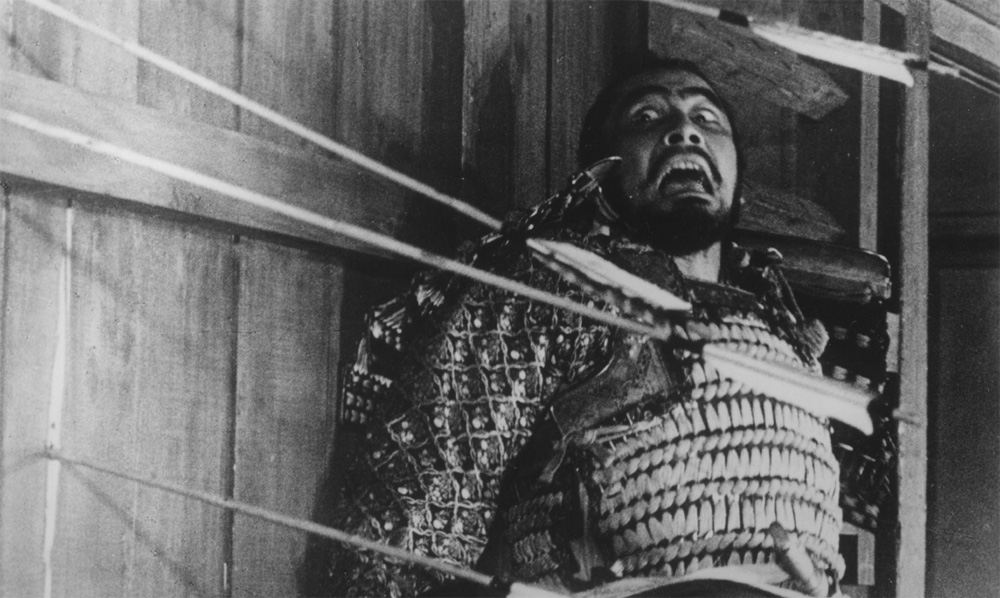
The climactic battle sequence, one of the most iconic scenes in Japanese cinema, is a perfect example of Kurosawa’s ability to use visual storytelling to heighten emotional and thematic impact. The film’s famous final scene, where Washizu is killed by arrows in the midst of a fog-covered battlefield, mirrors the film’s overall visual style, as the character meets his fate in an atmosphere of chaos and disillusionment. The arrows, which symbolize both the inevitability of fate and the consequences of his actions, rain down on Washizu in a visually stunning moment of poetic justice.

Legacy and Influence: An Enduring Masterpiece

Throne of Blood has had a profound impact on both Japanese cinema and global filmmaking. The film stands as one of Kurosawa’s greatest achievements and remains a timeless example of how classic literature can be effectively reinterpreted within a different cultural context. Kurosawa’s use of Noh theater elements, his exploration of the themes of ambition and guilt, and his innovative visual storytelling techniques have influenced generations of filmmakers across the world.

The film’s legacy extends beyond its initial impact in Japan, as it inspired filmmakers such as Martin Scorsese, George Lucas, and Francis Ford Coppola, all of whom have cited Kurosawa’s work as a significant influence on their own films. Throne of Blood continues to be a vital part of the cinematic canon, studied for its artistic merit, thematic depth, and masterful direction.

Conclusion: A Timeless Tragedy of Power and Fate

Throne of Blood (1957) remains one of Akira Kurosawa’s most revered films, seamlessly blending the timeless themes of Shakespeare’s Macbeth with the rich cultural heritage of Japan. Through its striking performances, innovative direction, and atmospheric cinematography, the film explores the corrupting effects of ambition, the inevitability of fate, and the destructive nature of power. Kurosawa’s ability to reimagine Shakespeare’s tragedy within a samurai context is a testament to his genius, and Throne of Blood continues to stand as a haunting, visually arresting meditation on the human condition.

Kapolda Sumsel Tinjau Pengamanan Natal dan Berikan Imbauan Keamanan

ist-pasion.com – Menjelang perayaan Natal 2024, Kapolda Sumatera Selatan (Sumsel) meninjau langsung pengamanan di sejumlah gereja di Palembang. Tinjauan ini dilakukan untuk memastikan keamanan dan kenyamanan jemaat yang akan merayakan Natal. Kapolda Sumsel juga memberikan imbauan kepada masyarakat untuk tetap waspada dan meningkatkan kewaspadaan terhadap potensi ancaman keamanan.

Pengamanan Ketat di Gereja Katolik Santa Maria

Salah satu gereja yang mendapatkan pengamanan ketat adalah Gereja Katolik Santa Maria di Kambang Iwak, Palembang. Usai tragedi bom bunuh diri di tiga gereja di Surabaya, Jawa Timur, pengamanan di Gereja Katolik Santa Maria langsung diperketat. “Kami langsung melakukan pengamanan ketat pagi tadi setelah Misa Minggu di Gereja Santa Maria,” kata Babinsa Koramil Pakjo Kodim 0418, Aris Munthe1.

Pengamanan di gereja ini dilakukan oleh personel gabungan TNI dan polisi. “Untuk kondisi para jemaat setelah mengetahui kejadian bom bunuh diri di gereja Surabaya terlihat turut prihatin dan ada rasa waspada, tetapi setelah dilakukan pengamanan ketat sejak misa pagi, jemaat mulai merasa aman melanjutkan misa,” ujar Aris Munthe1.

Di depan pintu Gereja Katolik Sbobet88 Santa Maria, yang saat ini tengah dilakukan pemagaran untuk renovasi, terlihat spanduk gerakan peduli kamtibmas agar umat dan masyarakat meningkatkan kewaspadaan keamanan1.

Pengamanan di Gereja Katolik Santo Yosep

Sementara itu, di Gereja Katolik Santo Yosep di Jalan Jenderal Sudirman, Palembang, suasana usai ibadah misa siang tidak tampak pengamanan ekstra. Namun, pihak pengamanan internal gereja mengatakan bahwa usai berita teror bom bunuh diri di Surabaya, ada patroli dari TNI dan Polisi yang datang meninjau ke halaman gereja1.

Pukul 17.00 WIB sore nanti akan digelar misa Minggu di gereja ini. Diharapkan umat tidak khawatir dan tetap menjalankan ibadah seperti biasa1.

Imbauan Kapolda Sumsel

Kapolda Sumsel, dalam tinjauannya, menekankan pentingnya kewaspadaan dan kerjasama antara masyarakat dan aparat keamanan. “Kami mengimbau kepada seluruh masyarakat untuk tetap waspada dan meningkatkan kewaspadaan terhadap potensi ancaman keamanan. Keamanan adalah tanggung jawab kita bersama,” ujar Kapolda Sumsel1.

Kapolda juga mengapresiasi langkah-langkah pengamanan yang telah dilakukan oleh pihak gereja dan aparat keamanan. “Kami berterima kasih kepada seluruh pihak yang telah bekerja keras untuk memastikan keamanan dan kenyamanan jemaat yang akan merayakan Natal,” tambahnya1.

Harapan untuk Perayaan Natal yang Aman

Dengan adanya pengamanan yang ketat dan imbauan dari Kapolda Sumsel, diharapkan perayaan Natal 2024 di Sumatera Selatan dapat berjalan dengan aman dan lancar. Masyarakat diimbau untuk tetap tenang dan tidak terpancing oleh isu-isu yang dapat menimbulkan keresahan.

Confessions (2010): A Dark Exploration of Revenge & Guilt

ist-pasion.com – Confessions (2010), directed by Tetsuya Nakashima, is a disturbing and emotionally charged psychological thriller that explores the depths of human anger, guilt, and revenge. Based on the novel by Kanae Minato, Confessions takes the audience on a harrowing journey through the lives of its central characters, examining the devastating consequences of crime, the complexity of justice, and the consequences of unaddressed trauma. Known for its dark themes and intricate narrative, the film received widespread acclaim for its compelling storytelling and powerful performances.

Confessions is often praised for its emotional intensity and narrative structure, which blends elements of mystery, thriller, and tragedy. With its tightly woven plot, striking visual style, and shocking revelations, the film has garnered both critical and commercial success, becoming one of the most memorable Japanese films of the 2010s.

Plot Overview

The story of Confessions centers on Yuko Moriguchi (played by Takako Matsu), a middle school teacher whose life is turned upside down after the tragic death of her 4-year-old daughter, Manami. Manami’s death is ruled as an accident, but Yuko soon learns that the truth behind her daughter’s death is far darker than she could have imagined. She discovers that two of her students, Shuya and Naoki, were responsible for the murder of her daughter, and their crime was covered up by their classmates and the school administration.

Yuko, consumed by grief and a desire for revenge, takes matters into her own hands. In an emotionally charged class session, she reveals to her students that she knows the truth about her daughter’s death and that she has meticulously planned her own form of justice. Yuko’s confession sets off a chain reaction, as the lives of the students involved in the crime spiral out of control. Through a series of confessions, the film reveals the dark motivations, hidden secrets, and moral dilemmas of each character, creating a complex web of guilt, remorse, and vengeance.

The film’s narrative unfolds through multiple perspectives, each character offering their own viewpoint on the events that led to Manami’s death and the impact of Yuko’s revelations. As the story progresses, the audience is led to question the nature of justice, the reliability of personal perception, and the devastating consequences of secrets left uncovered.

Themes: Revenge, Guilt, and the Impact of Trauma

Revenge as a Form of Justice

The central theme of Confessions is revenge, which drives the entire narrative. Yuko Moriguchi’s decision to seek justice for her daughter’s murder in her own way raises important questions about the moral implications of revenge and the limits of the law. While the justice system fails to deliver any real consequences for the two students responsible for her daughter’s death, Yuko takes matters into her own hands, seeking a form of closure that the law cannot provide.

Throughout the film, Yuko’s actions are depicted as both tragic and deeply human. She is not merely seeking vengeance for the sake of vengeance; her desire for justice is fueled by the overwhelming grief of losing her daughter. However, as the story progresses, the question of whether her actions are truly justified becomes more complicated. Yuko’s plan for revenge has far-reaching consequences for everyone involved, including the students, their families, and even herself.

The film explores the idea that revenge, while seemingly a form of justice, can often perpetuate a cycle of pain and destruction, leading to irreversible consequences. The characters in Confessions struggle with their own sense of justice, and the film ultimately suggests that seeking revenge may not offer the closure one expects, but only deepen the emotional wounds.

Guilt and Accountability

Another major theme in Confessions is guilt, particularly how the characters cope with the weight of their actions and the burden of their secrets. The film highlights how guilt can manifest in different ways, whether as emotional numbness, denial, or an obsessive need to atone for past wrongs.

The two boys responsible for Manami’s death—Shuya and Naoki—are depicted as complex characters with their own moral dilemmas. While their crime is horrific, the film offers insight into their backgrounds and the factors that led them to commit the act. Shuya, for instance, is shown as a deeply troubled individual, motivated by a mix of anger, alienation, and a desire for attention. Meanwhile, Naoki is portrayed as a more passive participant, someone who goes along with Shuya’s plans but struggles with his conscience afterward.

Yuko’s own guilt is also a key element of the story. While she feels justified in her quest for revenge, she also grapples with the fact that her actions may be just as damaging as those of the students who murdered her daughter. The film suggests that guilt is not simply about the acknowledgment of wrongdoing but is deeply tied to the need for recognition, confession, and atonement.

The theme of guilt is intertwined with the idea of accountability. Each character in Confessions is forced to confront their role in the tragedy, whether as a perpetrator or an enabler. The film’s structure, which shifts between different characters’ perspectives, underscores how guilt can be subjective, with each individual seeing the events through their own lens of experience.

Trauma and Its Consequences

The film also delves into the lasting effects of trauma, particularly how it shapes the lives of those involved. Yuko’s trauma is evident in her obsessive desire for revenge, and her inability to move on from the loss of her daughter. Her actions are a direct response to the emotional scars left by her daughter’s death, and the film explores how trauma can distort one’s sense of reality and morality.

The trauma experienced by the students involved in the crime also plays a significant role in the narrative. While they may not have directly faced the same level of emotional devastation as Yuko, their own lives are forever changed by the events. As the truth behind Manami’s death is revealed, it becomes clear that the characters are all trapped by the consequences of their actions, unable to escape the psychological and emotional scars of the past.

The film suggests that trauma is not something that can simply be “fixed” or erased. The characters must learn to confront their pasts and take responsibility for their actions, even as they struggle with feelings of shame and regret.

Cinematic Style and Visuals

Tetsuya Nakashima’s direction in Confessions is marked by its meticulous attention to detail and its use of striking visual imagery to amplify the emotional impact of the story. The film’s visual style is both haunting and elegant, with a blend of cold, clinical shots and rich, vibrant colors that evoke a sense of unease. The cinematography, by Shoichi Ato, uses close-ups and slow-motion sequences to emphasize the emotional intensity of the characters’ confessions and the psychological depth of the film.

One of the most distinctive features of Confessions is its non-linear narrative, which unfolds through multiple viewpoints and fragmented storytelling. The film shifts between the perspectives of different characters, allowing the audience to see the events from various angles and providing insight into the motivations and emotions of each individual. This structure enhances the complexity of the narrative, revealing new layers of the story with each confession.

The soundtrack, composed by Keiichi Suzuki, further adds to the film’s atmosphere. The music is often haunting, with a mix of minimalist piano pieces and more dramatic orchestral scores that punctuate key emotional moments. The film’s use of sound and silence is deliberate, creating a sense of tension and unease that mirrors the psychological states of the characters.

Reception and Legacy

Confessions received critical acclaim upon its release, with praise directed at its sharp direction, strong performances, and its exploration of complex themes. Takako Matsu’s portrayal of Yuko was widely lauded for its depth and emotional range, and the film’s gripping narrative kept audiences on the edge of their seats. The film’s success extended beyond Japan, earning international recognition and winning several awards, including Best Film at the Japanese Academy Awards.

The film’s dark, thought-provoking themes and its haunting atmosphere have made Confessions a standout entry in the psychological thriller genre. It has been compared to other works of Asian cinema that explore the complexities of revenge and guilt, such as Oldboy (2003) and The Chaser (2008). Confessions stands out, however, for its unique narrative structure and its ability to make the audience question the nature of justice and morality.

Confessions also influenced a new wave of Japanese thrillers and psychological dramas, establishing Tetsuya Nakashima as one of the leading directors of his generation. His ability to weave intricate narratives with emotional depth and shocking revelations has earned him a reputation as a master of psychological storytelling.

Conclusion

Confessions (2010) is a masterfully crafted psychological thriller that explores themes of revenge, guilt, and trauma with emotional intensity and intellectual depth. Tetsuya Nakashima’s direction, combined with strong performances and a complex narrative, creates a film that is both thought-provoking and deeply unsettling. By focusing on the consequences of crime and the moral ambiguities of justice, Confessions forces the audience to confront difficult questions about human nature and the cost of vengeance. As a work of psychological horror and drama, it remains one of the most impactful and memorable films of the 2010s.

Last of the Red Hot Lovers: Bobbi Michele & the Pursuit of Passion

ist-pasion.com – Last of the Red Hot Lovers (1972), directed by Gene Saks, is a comedy based on Neil Simon’s Broadway play that explores themes of desire, middle age, and self-discovery. The film stars Neil Simon himself as the protagonist, Barney Cashman, a middle-aged man trying to rekindle the passion and excitement of his youth. One of the central characters who helps Barney along this journey is Bobbi Michele, portrayed by [insert actress’s name]. Bobbi is an important figure in the film, representing the contrast between the disillusioned past and the uninhibited present as Barney tries to live out a fantasy of sexual freedom. Bobbi’s character adds a layer of complexity to the film’s humorous but poignant exploration of identity, relationships, and the complexities of human nature.

Plot Overview: Barney’s Quest for Passion

Last of the Red Hot Lovers follows the story of Barney Cashman, a 47-year-old, somewhat conservative and repressed man who seeks to break free from the confines of his suburban life and spice things up with an affair. Barney is married to his wife, who is somewhat indifferent to their sex life, and he feels increasingly disconnected from the world around him. In a bid to recapture the excitement of youth, Barney arranges a series of encounters with different women in an effort to experience the world of passion he has missed out on.

Bobbi Michele, played by [insert actress’s name], is one of the women Barney meets in his search for adventure. Bobbi is an eccentric, free-spirited woman who contrasts sharply with Barney’s own personality. She embodies the type of passionate, uninhibited character that Barney fantasizes about, and her presence in the film becomes central to his attempt to rediscover a side of himself he feels he has lost.

Bobbi Michele: The Free Spirit Who Challenges Barney’s World

Bobbi Michele is an integral character in Last of the Red Hot Lovers, offering a stark contrast to Barney’s stifled existence. Unlike Barney, Bobbi is a liberated woman who embraces her sexuality and is unencumbered by the inhibitions that define much of his life. She is confident, bold, and unapologetic, and it is through her that Barney hopes to fulfill his fantasies of freedom and passion.

Bobbi’s character is far from conventional, and her unconventional behavior and outlook challenge Barney’s perceptions of relationships and intimacy. While Barney seeks an escape from the mundanity of his life through an affair, Bobbi represents the possibility of living authentically without constraints. However, her liberated nature also exposes the fragility of Barney’s expectations, as the encounter with Bobbi does not fulfill the idealized vision of passion he had hoped for.

Bobbi’s interaction with Barney reveals the contradictions inherent in his quest. She is a character who embraces the freedom that Barney desires, yet the encounter with her exposes the complexities and misunderstandings that arise from the search for intimacy. Bobbi’s unapologetic nature and willingness to be herself make her a compelling presence in the film, as she pushes Barney to confront his own limitations and desires.

Themes of Aging, Identity, and Self-Discovery

At its core, Last of the Red Hot Lovers is a comedy about aging and self-discovery. Barney’s quest for passion reflects a deeper existential struggle to reclaim his identity and purpose as he approaches middle age. Through his encounters with Bobbi and the other women, Barney confronts the tensions between his desires and the reality of his life.

Bobbi’s character, with her vibrant personality and refusal to conform, serves as a catalyst for Barney’s exploration of his own identity. She represents the possibility of living without the restrictions that Barney perceives in his own life, yet their encounter ultimately serves to highlight the gap between fantasy and reality. In this way, Bobbi becomes a mirror for Barney’s own self-perception, forcing him to confront the limits of his desires and the complexities of his relationships.

The film also deals with the changing dynamics of love and attraction in middle age. Barney’s quest for passion is not just about the physical act of sex but about rediscovering a sense of excitement and possibility in his life. Bobbi’s role in the narrative emphasizes the tension between the idealized notions of youth and passion and the more complex, often disappointing realities of human connection.

The Comedy of Last of the Red Hot Lovers

Although Last of the Red Hot Lovers deals with serious themes such as aging, self-esteem, and the search for fulfillment, it does so through the lens of comedy. The humor arises from the awkwardness and misunderstandings that occur during Barney’s encounters with the women he meets. The film’s lighthearted tone contrasts with the deeper emotional currents running through the narrative.

Bobbi’s character, with her eccentric personality and no-nonsense attitude, provides a comedic foil to Barney’s nervousness and fumbling attempts at seduction. Her presence highlights the absurdity of Barney’s situation, as he finds himself out of his depth in a world that is foreign to him. The film uses these comedic moments to explore the complexities of human desire, relationships, and identity, offering both humor and insight into the human condition.

The Film’s Legacy and Bobbi Michele’s Impact

Last of the Red Hot Lovers remains a classic exploration of the challenges and humor inherent in the search for meaning and passion in middle age. The film’s emphasis on self-discovery, personal limitations, and the complexities of relationships resonates with audiences even today. While Barney is the central character, Bobbi Michele’s role is crucial in highlighting the contradictions and emotional depth of his journey.

Bobbi’s character serves as both a symbol of freedom and a reflection of the challenges that come with living authentically. Through her interactions with Barney, the film examines the gap between fantasy and reality, and how one’s expectations can shape, and sometimes distort, their understanding of themselves and their desires. Bobbi Michele’s impact on the film is lasting, as she is an essential part of Barney’s emotional and personal growth throughout the story.

Conclusion

Last of the Red Hot Lovers (1972) is a comedic exploration of aging, desire, and self-discovery, with Bobbi Michele playing a key role in Barney Cashman’s journey of personal transformation. As a free-spirited woman who challenges Barney’s perceptions of passion and intimacy, Bobbi becomes a catalyst for the exploration of deeper themes, including identity, relationships, and the complex nature of human connection. The film’s comedic approach, combined with its insightful examination of the human condition, makes Last of the Red Hot Lovers an enduring classic that resonates with audiences seeking both humor and heart in the exploration of life’s complexities.

Mendes PDT Tinjau Pengungsian Korban Bencana di Sukabumi, Janji Relokasi

ist-pasion.com – Pada Senin, 23 Desember 2024, Menteri Desa dan Pembangunan Daerah Tertinggal (Mendes PDT) Yandri Susanto mengunjungi lokasi pengungsian korban bencana tanah bergerak di Desa Lembur Sawah, Pabuaran, Sukabumi, Jawa Barat. Kunjungan ini dilakukan untuk memastikan semua kebutuhan dasar pengungsi terpenuhi dan menjanjikan relokasi hunian tetap bagi para korban.

Yandri Susanto tiba di lokasi pengungsian bersama Wakil Menteri Desa dan PDT Ahmad Riza Patria serta Wakil Bupati Sukabumi Iyos Soemantri. Setiba di lokasi, mereka langsung mengecek tenda pengungsi dan dapur umum yang didirikan oleh relawan. Yandri juga berinteraksi langsung dengan para korban bencana untuk menanyakan kondisi mereka dan kebutuhan yang diperlukan.

“Kami datang ke sini ingin memastikan semua kebutuhan dasar terpenuhi. Ya tadi kami sudah tinjau tendanya, kemudian dapur umumnya, itu alhamdulillah bagus semua,” kata Yandri seusai meninjau lokasi6.

Selama kunjungan, Yandri juga melakukan koordinasi langsung dengan Kepala Badan Nasional Penanggulangan Bencana (BNPB) Letjen TNI Suharyanto untuk membahas relokasi rumah korban bencana. Yandri mendapat kabar bahwa rumah-rumah korban bencana di Kampung Lembur Tonggoh dan Lembur Pondok sudah tidak bisa dihuni lagi. Warga juga menyampaikan permintaan untuk direlokasi.

“Tadi saya sudah melakukan koordinasi langsung dengan Kepala BNPB, Pak Jenderal Suharyanto tentang relokasi Desa Lembursawah ke lokasi baru, yaitu akan dibangun huntap, hunian tetap,” jelas Yandri6.

Selain itu, Yandri juga berkontak langsung dengan Menteri Sosial (Mensos) Saifullah Yusuf untuk memastikan bantuan sosial segera disalurkan ke warga korban bencana tanah bergerak di Lembur Sawah. Mensos menyanggupi untuk menyalurkan bantuan-bantuan kebutuhan dasar, baik di daerah pengungsian maupun ketika mereka pindah ke tempat relokasi yang baru.

Yandri menjelaskan bahwa dana untuk membangun hunian tetap (huntap) akan diambil dari Dana Siap Pakai (DSP) BNPB yang telah disiapkan oleh Kementerian Keuangan untuk hal-hal darurat. Saat ini, BNPB dan pihak terkait tengah mengkaji lokasi untuk relokasi korban bencana agar hunian yang akan ditempati warga tidak mengalami bencana serupa.

“Sudah ada (lokasinya) insyaallah, tapi sekarang sedang di mapping betul tentang kontur tanahnya, ya kemudian sumber-sumber mungkin air bersihnya, ukuran tanahnya, kebutuhannya cukup atau nggak termasuk proses umumnya, sedang dimatangkan. Tapi tidak berlama-lama insyaallah akan kita lakukan pembangunan hunian tetap,” ujar Yandri.

Selama kunjungan, Yandri juga memastikan bahwa kebutuhan dasar seperti tenda, dapur umum, dan logistik lainnya sbobet login sudah terpenuhi. Ia juga menyerahkan 1.300 paket sembako kepada 297 keluarga yang terdampak bencana. Selain itu, Yandri menegaskan bahwa dana desa bisa digunakan untuk penanganan darurat bencana tanpa melanggar aturan.

Kunjungan Mendes PDT Yandri Susanto ke lokasi pengungsian korban bencana di Sukabumi menunjukkan komitmen pemerintah untuk memastikan kebutuhan dasar pengungsi terpenuhi dan memberikan solusi jangka panjang melalui relokasi hunian tetap. Koordinasi dengan berbagai pihak terkait, termasuk BNPB dan Mensos, menjadi kunci dalam upaya penanganan bencana ini. Dengan adanya rencana relokasi dan bantuan yang disalurkan, diharapkan para korban bencana dapat segera mendapatkan hunian yang layak dan aman.

Salo: The Rich and Flavorful Cured Pork Fat

ist-pasion.com – Salo is a traditional Eastern European delicacy that has been enjoyed for centuries, particularly in Ukraine, Russia, and Poland. This unique dish consists of cured pork fat, often served thinly sliced and accompanied by bread, garlic, and sometimes onions or pickles. While it may sound simple, salo holds a special place in the hearts of many, prized for its rich flavor and versatility. It is more than just a food item; it’s a part of the cultural heritage in many Eastern European countries.

The Process of Making Salo

The preparation of salo involves curing pork fat, typically taken from the belly or back of the pig. The fat is carefully salted and sometimes seasoned with additional spices, garlic, or herbs. This curing process preserves the fat and enhances its flavor, allowing it to be stored for long periods.

There are several methods of curing salo:

  • Dry Curing: In the dry curing method, the pork fat is rubbed with a generous amount of salt and sometimes garlic, pepper, or other seasonings. It is then left to cure for several weeks, allowing the flavors to develop.
  • Brining: In this method, the pork fat is submerged in a salty brine, sometimes with additional spices like bay leaves, coriander, or dill. This creates a slightly different flavor profile compared to dry curing.
  • Smoking: Some variations of salo involve smoking the cured fat, which imparts a smoky flavor that enhances the overall taste. The fat is smoked slowly over wood, adding depth to its flavor.

Once cured, salo can be eaten as-is or further aged to intensify its flavor. It can be stored for months in cool, dry conditions, making it an excellent long-lasting food source.

Serving Salo

Salo is traditionally served thinly sliced, often on slices of hearty bread. The fat itself has a smooth, melt-in-your-mouth texture, and when paired with the right accompaniments, it becomes a delightful treat. Some common ways to serve salo include:

  • With Garlic and Bread: The simplest and most traditional way to enjoy salo is with thick, crusty bread and a smear of crushed garlic. The garlic enhances the rich, savory flavor of the fat, and the bread serves as a perfect base.
  • Pickles: Many people serve salo alongside pickled vegetables, such as cucumbers or tomatoes. The acidity of the pickles contrasts beautifully with the richness of the fat.
  • Onions: Thinly sliced onions, often raw or pickled, are another common accompaniment. Their sharpness complements the fatty texture of the salo, balancing the flavors.
  • Spices: In some variations, salo is seasoned with black pepper, paprika, or other spices before being served. This adds an extra layer of flavor and complexity.

Salo is often enjoyed as a snack or appetizer, but it can also be served as part of a larger meal. It is commonly eaten with strong drinks like vodka, which help cut through the richness of the fat.

Cultural Significance of Salo

Salo is more than just a food item; it is a symbol of tradition, resilience, and cultural pride in Eastern Europe. Historically, salo was a vital source of nutrition, especially in rural areas where it was often produced at home and stored for the winter months. The preservation of pork fat through curing allowed families to have a reliable food source during harsh seasons when fresh food was scarce.

In Ukraine, salo is considered a national treasure and has even been honored in songs, poems, and folklore. It is often associated with hospitality and is commonly served at family gatherings, celebrations, and holidays.

In addition to its culinary role, salo has also found its way into the world of folk medicine. It is believed by some to have healing properties, especially for respiratory issues, and is sometimes used in homemade remedies.

Variations of Salo Around the World

While salo is most closely associated with Ukraine, Russia, and Poland, similar dishes can be found in other parts of the world:

  • Lardo: In Italy, a similar product known as “lardo” is made from the fatty layer of pig’s back and is cured with herbs and spices. Lardo is often sliced thin and served on bread, much like salo.
  • Speck: In Austria and Germany, speck is a type of cured pork fat that is smoked and seasoned. While it is typically leaner than salo, it shares similarities in flavor and texture.
  • Sjömat (Swedish Lard): In Sweden, a variation of cured lard called “sjømat” is made, and it is sometimes flavored with juniper berries or other herbs. It is served with bread or crackers, similar to salo.
  • Bacon: While bacon is often cooked, the idea of preserving pork fat is present in many cultures around the world, from American bacon to various regional types of pancetta.

Conclusion

Salo is a simple yet luxurious dish that has deep roots in Eastern European culinary traditions. Its rich, salty flavor and smooth texture make it a beloved treat, enjoyed by many as a snack, appetizer, or part of a larger meal. Whether served with garlic, bread, pickles, or onions, salo provides a delicious and hearty experience that connects people to their cultural heritage. For those who appreciate bold flavors and time-honored traditions, salo is a must-try dish that continues to delight and satisfy.

The Raccoon: A Resourceful and Mischievous Mammal

ist-pasion.com – Raccoons are one of the most recognizable and adaptable mammals in North America. Known for their distinctive black “mask” of fur around their eyes, dexterous front paws, and curious nature, raccoons have become a symbol of resourcefulness and mischief. Part of the Procyonidae family, raccoons are highly intelligent and capable of thriving in both wild and urban environments. This article explores the characteristics, behavior, diet, habitat, and role of raccoons in ecosystems.

1. What is a Raccoon?

The raccoon (Procyon lotor) is a medium-sized mammal native to North America, though its range has expanded to parts of Europe and Asia. It is easily recognizable by its bushy tail, which typically has several black rings, and its black facial mask, formed by dark fur around the eyes. Raccoons are part of the Procyonidae family, which also includes animals like the coati, kinkajou, and ringtail.

Raccoons are omnivorous, opportunistic feeders, which means they will eat a wide variety of food depending on availability. They are known for their adaptability and have successfully established themselves in urban areas, where they often forage through trash cans and urban parks. Despite their sometimes mischievous reputation, raccoons are highly intelligent creatures, capable of solving complex problems and using tools.

2. Physical Characteristics of Raccoons

Raccoons have distinctive physical features that set them apart from other mammals. The most noticeable is their black “mask” of fur around their eyes, which gives them a masked appearance and is one of the defining characteristics of the species. Their fur is typically grayish-brown, though it may have a more reddish or yellowish tint depending on their location and diet. The raccoon’s bushy tail is another standout feature, usually with 4–6 black rings that are visible even from a distance.

Raccoons have agile, dexterous front paws that resemble human hands, which they use for a wide variety of tasks. These paws allow raccoons to open containers, unlock cages, and manipulate objects with surprising precision. Their ability to “wash” food before eating (often mistaken for actual washing, but more of a behavior to inspect the food) is another unique behavior that stems from the raccoon’s sensitivity in its paws.

Adults typically weigh between 8 to 24 pounds (3.5 to 11 kg), though this can vary by species and region. They have a relatively small face and a long, bushy tail, giving them a compact but agile body suited for climbing, scavenging, and foraging.

3. Raccoon Behavior and Social Structure

Raccoons are solitary animals, though they can sometimes be found in small groups, especially during the breeding season or when resources are abundant. They are nocturnal creatures, meaning they are most active during the night. This nocturnal behavior helps raccoons avoid predators and take advantage of the cooler, quieter night hours to forage for food.

Raccoons are highly curious and intelligent, often getting into places where they aren’t supposed to be—such as trash cans, attics, and even homes. This curiosity and problem-solving ability make them highly adaptable and capable of living alongside humans in urban environments. In fact, raccoons are often seen as a nuisance in cities and towns, where they scavenge through garbage and raid bird feeders.

Though generally solitary, raccoons will sometimes form groups during certain periods, particularly during the winter months when they share dens for warmth. These temporary social arrangements are typically not long-lasting, as raccoons are territorial and prefer solitude for most of the year.

4. Raccoon Diet and Feeding Habits

Raccoons are omnivores with an opportunistic diet, meaning they will eat whatever food is available. In the wild, their diet primarily consists of fruits, nuts, seeds, insects, small mammals, and amphibians. They are also known to hunt for fish, crayfish, and other aquatic organisms if they live near water sources. Raccoons will often dig in the ground for insects and earthworms, and they have been known to raid bird nests for eggs.

In urban environments, raccoons are notorious for scavenging garbage cans, compost bins, and pet food left outdoors. They are often seen rummaging through trash in search of discarded food, and their ability to open containers with their dexterous paws only adds to their reputation as clever and persistent creatures.

Raccoons are also known for their “washing” behavior, which involves dipping food into water before eating it. While it may appear as though they are washing their food, this behavior is actually an instinctive action to examine and manipulate the food more thoroughly using their sensitive paws. This behavior is more likely to occur if they have access to a water source.

5. Raccoon Habitat and Range

Raccoons are highly adaptable creatures that can live in a wide range of habitats, from dense forests and wetlands to suburban neighborhoods and urban areas. They are commonly found in forests, woodlands, marshes, and along rivers, where they have access to food sources like fruits, insects, and small animals.

In urban areas, raccoons thrive in parks, yards, and rooftops, often taking shelter in attics, chimneys, and abandoned buildings. Their ability to navigate both natural and human-modified environments has contributed to their successful adaptation to cities, where they find abundant food and shelter. Raccoons are proficient climbers, and they are equally at home in trees as they are on the ground, where they dig and search for food.

While raccoons are capable of surviving in almost any habitat, they prefer environments that provide food, water, and adequate shelter. Dens can range from hollow trees and burrows to man-made structures such as sheds or garages.

6. Raccoon Conservation Status

Raccoons are not considered endangered, and in fact, their populations have flourished in many areas due to their adaptability and opportunistic feeding habits. They are classified as Least Concern by the International Union for Conservation of Nature (IUCN), meaning that they do not currently face significant threats to their survival.

However, raccoons do face some risks, particularly from habitat loss, road traffic, and disease. In urban areas, raccoons are at risk of coming into contact with vehicles and human-made hazards, such as pesticides and traps. They can also contract diseases such as rabies, distemper, and leptospirosis, which can affect both raccoons and other wildlife populations.

7. Fun Facts About Raccoons

  • Raccoons have a “hand-like” dexterity in their front paws, which allows them to open doors, containers, and even unlock cages.
  • The black “mask” around a raccoon’s eyes helps reduce glare from the sun and improves its vision at night.
  • Raccoons are excellent swimmers and are able to dive underwater to catch fish or forage in aquatic environments.
  • A group of raccoons is sometimes called a “gaze,” although raccoons are typically solitary animals.
  • The “washing” behavior is actually a way for raccoons to manipulate and inspect their food using their sensitive paws, not a literal washing action.

8. Conclusion

Raccoons are highly adaptable, intelligent creatures that have learned to thrive in both wild and urban environments. Their curiosity, dexterous paws, and nocturnal habits have made them one of the most resourceful mammals in North America. Whether foraging in forests or scavenging through city streets, raccoons are experts at finding food and making their homes in a variety of environments. While they may sometimes be seen as mischievous pests, raccoons play an important role in ecosystems by controlling insect populations, dispersing seeds, and contributing to biodiversity. Understanding their behavior and role in nature can help humans coexist with these fascinating animals.

Universitas Indonesia: Melahirkan Generasi Unggul Sejak 1849

Universitas Indonesia (UI) merupakan perguruan tinggi dengan sejarah institusi pendidikan tertua di Asia. Awalnya, UI berdiri sebagai sekolah tinggi ilmu kesehatan yang didirikan oleh Belanda pada tahun 1849 dan resmi dikenal dengan nama Dokter-Djawa School pada tahun 1851. Pada tahun 1898, sekolah ini berubah nama menjadi School tot Opleiding van Indische Artsen (STOVIA), yang menjadi pusat pendidikan kedokteran terbaik di Indonesia selama 75 tahun sebelum akhirnya ditutup pada tahun 1927.

Setelah STOVIA ditutup, pendidikan tinggi di Indonesia berkembang dengan pendirian beberapa sekolah tinggi lain di Pulau Jawa. Contohnya adalah Technische Hoogeschool te Bandoeng (Fakultas Teknik) di Bandung pada 1920, Recht Hoogeschool (Fakultas Hukum) di Batavia pada 1924, Faculteit der Letteren en Wijsbegeerte (Fakultas Sastra dan Kemanusiaan) di Batavia pada 1940, dan Faculteit van Landbouwweteschap (Fakultas Pertanian) di Bogor pada 1941. Gabungan dari lima sekolah tinggi ini melahirkan sebuah universitas bernama Nood-universiteit (Universitas Darurat) pada tahun 1946, yang menjadi cikal bakal Universitas Indonesia.

Dalam hal pembiayaan pendidikan untuk program Sarjana Reguler di UI, terdapat dua mekanisme utama untuk biaya operasional (BOP) atau pembayaran per semester:

  1. BOP-Berkeadilan: Skema ini memungkinkan besaran Uang Kuliah Tunggal (UKT) yang dibayarkan disesuaikan dengan kemampuan finansial mahasiswa. Proses pengajuan membutuhkan berbagai dokumen dan data pendukung.
  2. BOP-Pilihan: Dalam skema ini, mahasiswa dapat menentukan sendiri jumlah UKT yang ingin dibayarkan, sebagai bentuk partisipasi dalam membantu biaya operasional pendidikan di program Sarjana Reguler.

UI terus menjadi institusi pendidikan terkemuka yang melahirkan generasi unggul untuk masa depan Indonesia. Berikut fakultas yang tersedia untuk kalian pilih di Universitas Indonesia :

  • Fakultas Ilmu Pengetahuan Budaya
  • Fakultas Ekonomi dan Bisnis
  • Fakultas Ilmu Komputer
  • Fakultas Farmasi
  • Fakultas Hukum
  • Fakultas Kedokteran
  • Fakultas Ilmu Administrasi
  • Fakultas Ilmu Keperawatan
  • Fakultas Ilmu Sosial Ilmu Politik
  • Fakultas Kesehatan Masyarakat
  • Fakultas Kedokteran Gigi
  • Fakultas Psikologi
  • Fakultas Teknik
  • Fakultas Pendidikan Vokasi
  • Fakultas Matematika dan Ilmu Pengetahuan Alam

Baca Juga : Universitas Terupdate Jurusan Game

Stasiun Kereta Cepat Karawang Resmi Beroperasi 24 Desember 2024, Gibran Pastikan Kesiapan Infrastruktur

ist-pasion – Wakil Presiden Gibran Rakabuming Raka memastikan bahwa Stasiun Kereta Cepat Karawang akan siap beroperasi mulai 24 Desember 2024. Peninjauan langsung dilakukan oleh Gibran pada Jumat (20 Desember 2024) untuk memastikan proyek ini selesai tepat waktu dan dapat digunakan selama libur Natal dan Tahun Baru (Nataru) 2024/2025.

“Insya Allah, stasiun yang di Karawang siap pada 24 Desember,” ujar Gibran dalam keterangan resminya. Selain kesiapan stasiun, Gibran juga menekankan pentingnya akses jalan tol untuk mendukung kelancaran mobilitas masyarakat selama libur Nataru. Beberapa ruas tol fungsional sementara direncanakan akan segera dibuka untuk mengatasi kemacetan dan penumpukan yang mungkin terjadi.

Gibran mengajak semua pihak terkait untuk mempersiapkan fasilitas dan infrastruktur dengan memprioritaskan aspek keamanan dan keselamatan, terutama di titik-titik strategis. “Kita tidak ingin ada kemacetan atau penumpukan selama Nataru,” tegasnya.

Stasiun Whoosh Karawang, yang sebelumnya telah beroperasi sejak Oktober 2023, akan secara resmi melayani naik turun penumpang mulai 24 Desember 2024. Pada tahap awal, stasiun ini akan melayani 20 jadwal kereta, terdiri dari 10 keberangkatan dari Stasiun Whoosh Halim dan 10 keberangkatan dari Stasiun Whoosh Tegalluar Summarecon atau Padalarang. Dengan menggunakan Kereta Cepat Whoosh, rute Halim-Karawang dapat ditempuh dalam waktu 15 menit, sementara rute Karawang-Padalarang dapat ditempuh dalam waktu 20 menit.

Selain itu, pemerintah juga sedang menyiapkan pembangunan exit KM 42 Jalan Tol Jakarta-Cikampek yang langsung menuju kawasan Stasiun Kereta Cepat di Karawang. Akses lain dari Tol Japek juga sedang dalam tahap pembebasan lahan dan pembangunan medusa88. Dengan berbagai akses ini, Stasiun Karawang akan terkoneksi dengan berbagai kawasan industri, perkotaan, dan pusat perbelanjaan234.

Pembukaan Stasiun Whoosh Karawang diharapkan dapat memberikan kemudahan perjalanan bagi masyarakat Karawang dan sekitarnya, serta meningkatkan efektivitas waktu perjalanan dari Jakarta ke Karawang maupun Bandung ke Karawang. “Naik Whoosh, dari Halim-Karawang cuma perlu waktu kurang dari 30 menit saja. Ini pastinya jauh lebih cepat jika dibandingkan naik mobil,” ujar Wakil Menteri Perhubungan Suntana.

Dengan berbagai persiapan yang telah dilakukan, diharapkan libur Nataru tahun ini dapat berjalan lancar dan aman, serta memberikan pengalaman perjalanan yang nyaman bagi masyarakat yang menggunakan Kereta Cepat Whoosh.

The Elephant: Majestic Giants of the Earth

ist-pasion.com – Elephants, with their immense size, intelligence, and social structures, are among the most fascinating and beloved animals on the planet. Revered in many cultures for their strength and wisdom, elephants have captivated the human imagination for centuries. This article explores the different species of elephants, their physical characteristics, behaviors, and the conservation challenges they face in the modern world.

Physical Characteristics

Elephants are the largest land mammals, with two distinct species: the African elephant (Loxodonta africana) and the Asian elephant (Elephas maximus). Both species share several notable physical traits, including their large ears, trunk, and tusks, but there are some differences between them.

  • African elephants are larger than their Asian relatives and have more expansive ears shaped like the African continent. Their trunks are incredibly versatile, capable of performing a wide range of tasks from picking up food to drinking water and communicating with other elephants.
  • Asian elephants are smaller in size and have rounder ears compared to their African counterparts. Their trunks are similarly long and strong but tend to be somewhat shorter and less dexterous.

Both species have tusks, which are elongated incisors, and while both males and females of the African species typically have tusks, only male Asian elephants have them. Elephants’ thick skin is grayish in color, with folds and wrinkles that help retain moisture and protect against sun exposure.

Habitat and Distribution

Elephants are native to both Africa and Asia, each species occupying distinct regions. African elephants are found across sub-Saharan Africa, where they inhabit a variety of environments, including savannas, forests, and deserts. These elephants are more widely distributed than their Asian relatives and are found in countries such as Botswana, Kenya, Tanzania, and South Africa.

Asian elephants, on the other hand, are mostly found in forested areas across South and Southeast Asia, including India, Sri Lanka, Nepal, Thailand, and parts of Indonesia. Their habitats include tropical forests, grasslands, and wetlands.

Despite the wide range of habitats they occupy, both African and Asian elephants face challenges due to human activities, including habitat loss, human-wildlife conflict, and poaching for their tusks and other body parts.

Social Structure and Behavior

Elephants are known for their complex social structures, which are based on strong family bonds. In African elephants, herds are typically led by an older, experienced matriarch, often the oldest female in the group. These herds consist of related females and their offspring, and they are highly cooperative, working together to protect each other from predators and to care for the young.

Male elephants, called bulls, usually leave the herd when they reach maturity and tend to lead more solitary lives, only rejoining females for mating. However, bulls may also form loose bachelor groups.

Asian elephant social structures are somewhat similar but may be less rigid. Female Asian elephants live in matriarchal groups, while males also tend to live solitary lives, coming together with females only during the mating season.

Elephants are highly intelligent animals, capable of using tools, solving complex problems, and exhibiting emotions such as empathy and grief. They communicate through a variety of sounds, including trumpets, rumbles, and low-frequency vibrations, and they use their trunks to touch and interact with other elephants, conveying affection, reassurance, and social bonds.

Diet and Feeding Habits

Elephants are herbivores and play a crucial role in shaping their environment through their feeding habits. They are known as “keystone species” because their actions help maintain the balance of their ecosystems. Elephants can consume up to 300 pounds (136 kilograms) of vegetation each day, including grasses, fruits, leaves, bark, and twigs.

Their trunks are highly sensitive and act as a powerful tool for picking up food, sucking up water, and even socializing with others. Elephants have large molars that help them chew tough plant material, but they are also known to consume large amounts of water, sometimes drinking up to 50 gallons (190 liters) per day.

In addition to their role in plant consumption, elephants help disperse seeds through their droppings, which supports the regeneration of many plant species in their habitats. Their feeding habits also shape the landscape, as they sometimes uproot trees and create open spaces that benefit other species.

Conservation Status and Threats

Elephants face significant threats to their survival, primarily from habitat loss, poaching, and human-wildlife conflict. African elephants, particularly forest elephants, have seen a dramatic decline in population due to the ivory trade, which remains a major issue despite international bans on ivory sales. The African elephant population is currently listed as “Vulnerable” by the International Union for Conservation of Nature (IUCN), with certain populations, such as the forest elephant, critically endangered.

Asian elephants are also classified as “Endangered” by the IUCN, with their numbers dwindling due to habitat destruction, fragmentation, and human-wildlife conflict. In some regions, Asian elephants are forced to migrate through agricultural areas, where they can come into conflict with farmers. Habitat loss due to deforestation and the conversion of land for agriculture further exacerbates the challenges faced by Asian elephant populations.

Conservation efforts for elephants have become a global priority. These efforts include anti-poaching initiatives, habitat preservation, and strengthening the enforcement of international bans on the ivory trade. In some areas, human-elephant conflict mitigation strategies, such as the use of barriers or creating wildlife corridors, are helping to reduce the negative impact of human activities on elephant populations.

Conclusion

Elephants are truly magnificent creatures, known for their size, intelligence, and social bonds. Their roles as ecosystem engineers and keystone species are invaluable to the health of their environments. However, these majestic animals are facing numerous challenges, and their survival depends on continued conservation efforts, habitat protection, and global cooperation to combat poaching and the ivory trade.

By supporting conservation initiatives and promoting awareness about the plight of elephants, we can help ensure that future generations of these remarkable creatures continue to roam the earth, playing their essential role in maintaining the balance of nature.

Prince Sultan bin Abdulaziz: Saudi Arabia’s Former Crown Prince

ist-pasion.com – Prince Sultan bin Abdulaziz Al Saud (1928-2011) was a key figure in Saudi Arabia’s modern history, serving as Crown Prince of the Kingdom for nearly a decade. His contributions to the development of the Kingdom, both domestically and internationally, shaped Saudi Arabia’s position as a powerful and influential nation in the Middle East and beyond. Known for his dedication to public service, Prince Sultan played a pivotal role in the economic, military, and social advancement of Saudi Arabia. His leadership was instrumental in the Kingdom’s strategic development, modernization efforts, and in fostering strong international relations.

Early Life and Background

Born in 1928 in Riyadh, Prince Sultan was the 11th son of Abdulaziz Ibn Saud, the founder of modern Saudi Arabia, and a member of the powerful Al Saud family. Raised in the royal court, Prince Sultan was exposed to the governance of the Kingdom from a young age, as his father worked to unify the various tribes and regions of the Arabian Peninsula. The young prince was educated in Saudi Arabia and later received training in public administration, preparing him for a leadership role in the future.

His early career was marked by his military service and involvement in public affairs. Prince Sultan held various administrative roles within the Kingdom, including leadership positions in the Ministry of Communications and the Ministry of Defense, before assuming the role of Crown Prince in 2005, following the death of his brother, King Fahd.

Prince Sultan’s Role as Minister of Defense

One of Prince Sultan’s most significant contributions to Saudi Arabia was his role as Minister of Defense, a position he held from 1962 until his death. His leadership in the defense sector was crucial in transforming Saudi Arabia’s military capabilities, as he worked to modernize the armed forces and strengthen the Kingdom’s national security infrastructure.

Under his leadership, the Saudi military saw significant modernization, including the acquisition of advanced defense technology, military equipment, and the development of a well-trained, professional army. Prince Sultan was particularly instrumental in strengthening Saudi Arabia’s defense partnerships with Western nations, particularly the United States, securing key defense agreements that allowed Saudi Arabia to enhance its military readiness.

Prince Sultan also played an important role in the regional defense efforts, ensuring that Saudi Arabia was prepared for any potential threats from neighboring countries, including Iraq and Iran. His strategic decisions were critical during the Gulf War in 1990-1991, where Saudi Arabia played a central role in the international coalition that repelled the Iraqi invasion of Kuwait.

Economic and Social Development Initiatives

Beyond defense, Prince Sultan was a driving force behind Saudi Arabia’s economic diversification and modernization efforts. As Minister of Defense, he was not only responsible for military affairs but also for overseeing significant infrastructure projects that supported the Kingdom’s broader economic goals.

Prince Sultan’s leadership extended to various sectors of Saudi Arabia’s development, including the expansion of its oil and gas industry. He worked to ensure that the country’s energy resources were managed effectively, while also supporting initiatives to diversify the economy and reduce reliance on oil. His involvement in planning and overseeing economic projects helped shape the Kingdom’s modern infrastructure, including the construction of airports, ports, and highways that facilitated trade and transportation.

Additionally, Prince Sultan was a key figure in Saudi Arabia’s health and education sectors. He was a strong advocate for improvements in healthcare and education, leading to significant investments in the Kingdom’s medical facilities and educational institutions. His contributions to the development of universities and hospitals across Saudi Arabia have had a lasting impact on the Kingdom’s social and economic fabric.

Prince Sultan’s Diplomacy and International Influence

Prince Sultan was also a skilled diplomat who represented Saudi Arabia on the international stage. He was involved in numerous diplomatic efforts, helping to strengthen Saudi Arabia’s relationships with other Arab nations, as well as key global powers. His work in maintaining close ties with Western countries, particularly the United States, was crucial in ensuring the Kingdom’s strategic interests were advanced.

Prince Sultan’s diplomatic efforts were not limited to defense matters; he also played a significant role in Saudi Arabia’s approach to the Arab-Israeli conflict and the broader Middle Eastern political landscape. He was an advocate for peace in the region, supporting the Arab Peace Initiative proposed by Saudi Arabia in 2002, which called for a two-state solution to the Israeli-Palestinian conflict in exchange for Arab recognition of Israel.

He also sought to mediate and provide solutions to regional conflicts, including those in Lebanon and Yemen, working behind the scenes to promote stability in the region. His leadership on the global stage earned him respect among international leaders and helped position Saudi Arabia as a major player in global geopolitics.

Succession and Legacy as Crown Prince

In 2005, following the death of King Fahd, Prince Sultan was named Crown Prince of Saudi Arabia. Although he did not ascend to the throne before his death in 2011, his tenure as Crown Prince was marked by continued progress and modernization in Saudi Arabia. He worked to ensure stability within the royal family and the Kingdom, promoting internal reforms while upholding the Kingdom’s traditional values.

Prince Sultan’s legacy as Crown Prince is defined by his dedication to Saudi Arabia’s development, both in terms of security and social infrastructure. His efforts to strengthen the Kingdom’s military and economic foundation laid the groundwork for Saudi Arabia’s future growth and global influence. His commitment to modernization in various sectors contributed to the transformation of Saudi Arabia into a major economic and political power in the region.

Philanthropy and Charitable Contributions

Prince Sultan was also known for his philanthropic efforts. Throughout his life, he contributed generously to charitable causes in Saudi Arabia and beyond, focusing on humanitarian initiatives in healthcare, education, and disaster relief. He established several foundations aimed at improving the lives of the less fortunate, and his legacy of giving continues through the institutions he helped create.

Conclusion

Prince Sultan bin Abdulaziz’s legacy is that of a dedicated leader who played an instrumental role in shaping the modern Kingdom of Saudi Arabia. As Crown Prince, Minister of Defense, and a key diplomatic figure, he was a driving force behind the country’s economic development, military modernization, and international stature. His leadership and vision continue to influence Saudi Arabia today, and his contributions to the Kingdom’s progress will be remembered for generations. The impact of his work on the security, economy, and international standing of Saudi Arabia ensures that his legacy endures as one of the defining figures in the history of the Kingdom.

Udara Sampah Menggunung di Pasar Induk Caringin: Sebuah Krisis Lingkungan yang Mendesak

ist-pasion.com – Pasar Induk Caringin di Bandung, Jawa Barat, saat ini menghadapi krisis lingkungan yang serius akibat tumpukan sampah yang menggunung. Sampah tersebut telah menumpuk selama berbulan-bulan dan belum diangkut, menciptakan masalah kesehatan dan kenyamanan bagi warga sekitar.

Salah satu penyebab utama tumpukan sampah di Pasar Induk Caringin adalah minimnya ritase angkutan sampah. Hal ini menyebabkan sampah tidak dapat diangkut secara rutin, sehingga menumpuk dan menciptakan gunungan sampah yang besar. Selain itu, kurangnya teknologi dan infrastruktur yang memadai untuk mengelola sampah juga menjadi faktor penyumbang.

Tumpukan sampah yang tidak dikelola dengan baik dapat menyebabkan berbagai masalah kesehatan. Bau tak sedap yang dihasilkan dari sampah yang membusuk dapat menyebabkan ketidaknyamanan bagi warga sekitar dan bahkan dapat memicu masalah pernapasan. Selain itu, sampah yang menumpuk juga menjadi tempat berkembang biaknya serangga pembawa penyakit, yang dapat meningkatkan risiko penyakit menular.

Dari segi lingkungan, tumpukan sampah yang besar dapat mencemari tanah dan air di sekitarnya. Ketika hujan turun, air yang mengalir melalui tumpukan sampah dapat membawa polutan ke sumber air lokal, mencemari air minum dan ekosistem di sekitarnya.

Pengelola Pasar Induk Caringin dan Pemerintah Kota Bandung telah berupaya untuk mengatasi masalah ini dengan menggunakan teknologi baru untuk mengelola sampah. Namun, upaya ini masih belum cukup untuk mengatasi tumpukan sampah yang sudah sangat besar. Diperlukan solusi yang lebih komprehensif dan berkelanjutan untuk menangani masalah ini secara efektif.

  1. Peningkatan Infrastruktur Angkutan Sampah: Meningkatkan jumlah dan frekuensi angkutan sampah dapat membantu mengurangi tumpukan sampah di pasar.
  2. Penggunaan Teknologi Pengolahan Sampah Modern: Mengadopsi teknologi pengolahan sampah yang lebih efisien, seperti teknologi waste-to-energy (WtE), dapat membantu mengurangi volume sampah dan bahkan menghasilkan energi dari sampah yang diolah.
  3. Edukasi dan Kesadaran Masyarakat: Meningkatkan kesadaran masyarakat tentang pentingnya Medusa88 pengelolaan sampah yang baik dan pemilahan sampah dapat membantu mengurangi volume sampah yang harus diangkut dan diolah.
  4. Kerjasama dengan Sektor Swasta: Melibatkan perusahaan swasta dalam pengelolaan sampah dapat membawa inovasi dan efisiensi yang lebih besar dalam pengelolaan sampah.

Krisis tumpukan sampah di Pasar Induk Caringin adalah masalah serius yang memerlukan perhatian segera dan solusi komprehensif. Dengan peningkatan infrastruktur, adopsi teknologi modern, edukasi masyarakat, dan kerjasama dengan sektor swasta, masalah ini dapat diatasi secara efektif. Pemerintah, pengelola pasar, dan masyarakat harus bekerja sama untuk menciptakan lingkungan yang lebih bersih dan sehat bagi semua.

Slot Jepang Asli: Keunggulan yang Membuatnya Favorit

ist-pasion.com
Slot online terus menjadi pilihan utama para penggemar permainan digital di seluruh dunia. Salah satu yang semakin populer adalah slot Jepang asli, yang menawarkan keunikan dan fitur menarik. Baik itu dari tema, desain, maupun peluang besar untuk menang, berikut adalah keunggulan yang menjadikan slot Jepang favorit.

1. Desain Unik yang Mengangkat Budaya Jepang

Slot server Jepang dikenal dengan desainnya yang memukau dan terinspirasi dari budaya Jepang. Mulai dari simbol geisha, samurai, hingga festival tradisional, visualnya memikat hati pemain. Tidak hanya itu, efek suara yang khas, seperti alunan musik tradisional Jepang, menciptakan pengalaman bermain yang lebih imersif.

2. Peluang Menang Tinggi dengan Slot Gacor Jepang

Bagi pencinta slot gacor, slot Jepang sering menjadi pilihan karena menawarkan tingkat Return to Player (RTP) yang kompetitif. Banyak pemain melaporkan bahwa mereka lebih sering mendapatkan jackpot pada server ini dibandingkan dengan server lainnya.

3. Teknologi Terbaru pada Server Luar Negeri

Slot server Jepang menggunakan teknologi canggih untuk memastikan permainan berjalan mulus tanpa gangguan. Sistem ini dirancang untuk memberikan pengalaman bermain terbaik dengan keamanan data yang terjamin. Bagi pemain yang menggunakan akun pro slot server Jepang, keuntungan tambahan sering kali berupa akses ke fitur eksklusif dan hadiah spesial.

4. Ragam Tema yang Inovatif

Keunggulan lain dari slot Jepang adalah variasi temanya. Beberapa tema yang populer meliputi:

  • Slot Anime: Mengangkat karakter dari serial anime terkenal.
  • Slot Festival Jepang: Memberikan nuansa meriah dari festival seperti Tanabata atau Obon.
  • Slot Modern: Dengan tema futuristik yang menggabungkan elemen teknologi Jepang.

5. Ketersediaan di Server Luar Negeri

Slot Jepang tidak hanya tersedia di Jepang, tetapi juga dapat diakses melalui server luar negeri. Hal ini memudahkan pemain dari berbagai negara untuk menikmati permainan berkualitas tinggi. Server ini biasanya dilengkapi dengan berbagai opsi bahasa dan mata uang, sehingga pemain dapat bermain dengan lebih nyaman.

6. Kompatibilitas dengan Semua Perangkat

Slot server Jepang dirancang agar kompatibel dengan berbagai perangkat, baik itu komputer, tablet, maupun ponsel. Pemain dapat menikmati slot gacor Jepang kapan saja dan di mana saja tanpa batasan.

7. Fitur Bonus dan Jackpot yang Menggoda

Keunggulan terakhir yang menjadikan slot Jepang begitu digemari adalah fitur bonusnya. Dari putaran gratis hingga mini-games interaktif, setiap pemain memiliki peluang lebih besar untuk mendapatkan jackpot.

Penutup

Slot Jepang tidak hanya menawarkan permainan, tetapi juga pengalaman budaya yang unik. Dengan desain menarik, peluang menang tinggi, dan teknologi modern, tidak heran jika slot server Jepang menjadi favorit pemain di seluruh dunia. Jadi, jika Anda mencari permainan slot yang memberikan hiburan sekaligus keuntungan, cobalah slot Jepang asli untuk sensasi bermain yang berbeda!


Sheikha Fariha Al-Ahmad Al-Jaber Al-Sabah: A Legacy of Charity

ist-pasion.com – Sheikha Fariha Al-Ahmad Al-Jaber Al-Sabah, a late member of the Kuwaiti royal family, left an indelible mark on the country and beyond through her exceptional charity work and staunch advocacy for women’s rights. Known for her compassion and dedication to improving the lives of others, particularly women and marginalized groups, Sheikha Fariha’s legacy continues to inspire many. Throughout her life, she was a vocal proponent for gender equality, social justice, and community empowerment, helping to transform Kuwait’s approach to charitable giving and women’s rights.

Early Life and Royal Background

Sheikha Fariha was born into the esteemed Al Sabah family, Kuwait’s ruling royal family, which has a long-standing history of leadership and public service. The Al Sabah family has been instrumental in the governance of Kuwait for centuries, and Sheikha Fariha, as part of this prominent family, grew up with a strong sense of duty and responsibility to her country and its people.

Sheikha Fariha was well-educated and developed a keen understanding of the world’s social and political issues. Her royal status, coupled with her education, provided her with the unique opportunity to bring attention to causes that mattered most to her, particularly the well-being of women and the importance of charitable work.

Advocacy for Women’s Rights

Sheikha Fariha Al-Ahmad Al-Jaber Al-Sabah was an unwavering advocate for women’s rights, particularly in Kuwait and the Gulf region. While many women in the Middle East face significant barriers to equality, Sheikha Fariha used her position and influence to challenge societal norms, advocating for women’s empowerment, education, and participation in the workforce.

Throughout her life, Sheikha Fariha worked tirelessly to break down the cultural and societal barriers that often prevented women from fully participating in society. She believed that true progress could only be achieved by ensuring that women had equal opportunities in education, employment, and leadership roles. Her efforts to promote gender equality extended beyond mere advocacy; she worked directly with organizations and government bodies to create tangible change for women in Kuwait.

Sheikha Fariha’s efforts were especially significant during a time when many Middle Eastern countries were grappling with the limitations placed on women’s rights. Her advocacy for women’s education and empowerment served as a source of inspiration to countless women in Kuwait and the wider Gulf region, encouraging them to pursue their dreams and fight for their rights.

Charitable Work and Philanthropy

One of Sheikha Fariha’s most enduring legacies is her extensive philanthropic work. She was deeply committed to addressing the needs of the most vulnerable members of Kuwaiti society, including orphans, the elderly, and those with disabilities. Her charitable efforts spanned a wide range of initiatives, from supporting medical care and education to providing financial assistance for those in need.

As a passionate advocate for social justice, Sheikha Fariha played a pivotal role in the establishment and support of several charitable organizations, both within Kuwait and internationally. Through her philanthropic work, she sought to alleviate poverty, improve healthcare, and provide essential resources to underserved communities. Her contributions to healthcare initiatives, particularly those focused on children and women’s health, were invaluable, and she was known for her hands-on approach in ensuring that aid reached those who needed it most.

Sheikha Fariha also contributed to various cultural and educational programs, believing that access to knowledge and opportunity was key to addressing social inequalities. Her work in these fields has had a lasting impact, as she inspired others to give back to their communities and work toward a more just and equitable society.

Support for Women’s Empowerment Through Education

A key element of Sheikha Fariha’s advocacy was her belief in the power of education to uplift women and transform society. She strongly supported initiatives that provided women with access to education and vocational training, seeing it as the foundation for women to achieve economic independence and social empowerment.

In Kuwait, Sheikha Fariha worked closely with institutions to ensure that women had access to the highest levels of education. Her efforts to encourage girls’ education and expand opportunities for women in various professional fields were groundbreaking, and she worked to ensure that young women in Kuwait could pursue careers in sectors traditionally dominated by men, such as engineering, law, and business.

Through her charity work, Sheikha Fariha also supported scholarships and educational programs aimed at helping disadvantaged women gain the skills they needed to succeed. She was deeply committed to ensuring that women were not only educated but empowered to take on leadership roles in both the private and public sectors.

Health and Social Welfare Initiatives

Sheikha Fariha’s charitable contributions extended to healthcare and social welfare programs that aimed to improve the quality of life for many people in Kuwait. She played a significant role in supporting hospitals, clinics, and community health initiatives, ensuring that individuals had access to the medical care they needed.

In addition to her work in healthcare, Sheikha Fariha was deeply involved in social welfare programs that addressed issues such as homelessness, domestic violence, and the plight of refugees. Her efforts to provide shelter, food, and medical assistance to those in need were a testament to her compassion and commitment to making the world a better place.

Her work also focused on mental health, where she advocated for increased awareness and support for individuals struggling with psychological challenges. In Kuwait, mental health care has traditionally been a sensitive topic, but Sheikha Fariha’s advocacy helped to raise awareness and create more open discussions about mental health issues in the country.

A Lasting Legacy

Sheikha Fariha Al-Ahmad Al-Jaber Al-Sabah passed away in 2020, but her legacy continues to live on in the countless lives she touched through her charitable work, advocacy, and leadership. Her commitment to improving the lives of women, children, and marginalized communities has left a profound and lasting impact on Kuwait and the broader Gulf region.

Her vision for a more inclusive, just, and compassionate society continues to inspire new generations of leaders, particularly women, to fight for equality, social justice, and the rights of vulnerable populations. Sheikha Fariha’s life and work stand as a powerful reminder of the importance of philanthropy and the potential of individuals to make meaningful change in their communities.

Conclusion

Sheikha Fariha Al-Ahmad Al-Jaber Al-Sabah’s legacy is defined by her dedication to charitable causes and her lifelong advocacy for women’s rights. As a member of Kuwait’s royal family, she used her platform and influence to challenge societal norms, promote gender equality, and improve the lives of countless individuals in need. Through her philanthropic efforts, Sheikha Fariha transformed the lives of many, leaving behind a powerful example of how one person can make a lasting difference in the world. Her life continues to serve as an inspiration for all those working toward social justice, women’s empowerment, and community development.

The Diet of Monkeys: What Do These Primates Eat?

ist-pasion.com – Monkeys are a diverse group of primates found in various regions of the world, from tropical rainforests to mountainous regions. With over 300 species, monkeys have adapted to a wide range of habitats and food sources. As omnivores, their diet consists of a mixture of fruits, plants, insects, and sometimes small animals. Let’s explore the diverse diet of monkeys and how their feeding habits vary by species and habitat.

Omnivorous Diet: A Blend of Plant and Animal Foods

Monkeys are omnivores, meaning they eat both plant-based and animal-based foods. However, the majority of monkey species primarily rely on fruits, leaves, and other plant materials. Common food sources for monkeys include:

  • Fruits (such as bananas, berries, mangoes, and figs)
  • Leaves and flowers
  • Nuts and seeds
  • Insects (such as ants, termites, and caterpillars)
  • Birds and eggs
  • Small mammals (in some species)

While fruit is often the favorite food of many monkey species, they have a diverse diet that allows them to adapt to the seasonal availability of food. The ability to switch between plant and animal matter gives them an advantage in different habitats and conditions.

Fruit Lovers: The Role of Fruits in Monkey Diets

For many monkeys, fruits form a significant portion of their diet. They are especially attracted to sweet, ripe fruits because they provide high-energy sugars. In tropical rainforests, where fruit trees are abundant, monkeys are active foragers, often traveling long distances to find ripe fruits.

Some monkey species, like the spider monkeys and howler monkeys, are frugivorous, meaning that fruit makes up the majority of their diet. These monkeys are essential for seed dispersal, as they consume fruits and later excrete the seeds, contributing to forest regeneration.

Leaf Eaters: Monkeys That Rely on Vegetation

In addition to fruit, many monkeys consume a variety of plant materials, such as:

  • Leaves (both young and mature)
  • Flowers
  • Tree bark
  • Shoots

Certain species, like colobus monkeys and langurs, are folivorous, meaning they primarily eat leaves. These monkeys have specialized stomachs that allow them to digest tough, fibrous plant materials. Leaves are more abundant and stable year-round, making them an essential food source for these species.

Insects and Small Animals

While plant-based foods make up a large portion of a monkey’s diet, many species supplement their meals with protein-rich insects and small animals. Some of the common animal-based foods include:

  • Ants, termites, and beetles
  • Spiders and scorpions
  • Bird eggs and hatchlings
  • Small mammals (like rodents)

Monkeys are skilled at catching insects and hunting small prey. For example, capuchin monkeys are known for their intelligence and use of tools to access difficult-to-reach food, such as cracking open nuts or using sticks to extract insects from tree bark.

Dietary Variations by Species

The specific diet of monkeys varies depending on the species, habitat, and food availability. Below are some examples of how different monkey species have specialized diets:

  • Capuchin monkeys are known for their broad and adaptable diet, consuming everything from fruits and leaves to insects, small mammals, and even crabs.
  • Spider monkeys mainly eat fruits and are crucial for seed dispersal in tropical forests.
  • Howler monkeys rely heavily on leaves, as they have adapted to eat the tough vegetation in their environment.
  • Baboons, which live in more arid environments, eat a mix of fruits, roots, insects, and small animals, including small birds or even young antelopes.

Seasonal Changes in Diet

The availability of food in a monkey’s environment changes with the seasons, and monkeys adjust their diets accordingly. In the wet season, when fruits and insects are abundant, monkeys tend to eat more of these high-energy foods. During the dry season, when food is scarcer, monkeys may turn to leaves, seeds, and bark, which are more readily available but less nutritious.

Monkeys living in temperate or mountainous regions, such as Japanese macaques (snow monkeys), must also adjust their diet in colder months, relying on roots, bark, and even raiding farms for crops like sweet potatoes.

Social Feeding and Foraging

Monkeys are social animals that often forage for food in groups. This social behavior allows them to share information about food sources and increases their chances of finding food in dense forests or savannahs. In many species, young monkeys learn from older members of the group how to find and access different types of food.

Capuchin monkeys, for instance, are known to use tools, and young capuchins learn by observing the adults. Similarly, some monkey species have developed specific behaviors for catching insects or hunting small animals, which are passed down through generations.

Conclusion

Monkeys are highly adaptable omnivores with diverse diets that include fruits, leaves, insects, and small animals. Their diet varies significantly by species, habitat, and food availability, allowing them to thrive in a wide range of environments. Whether foraging for fruits in tropical rainforests, hunting insects in savannahs, or eating leaves in more temperate forests, monkeys play a crucial role in their ecosystems, from seed dispersal to pest control. Their versatility in finding food is one of the key factors behind their survival and widespread presence across the globe.

Tantangan dalam Memberantas Korupsi: Kepemimpinan KPK dan Pelanggaran Etik

ist-pasion.com – Komisi Pemberantasan Korupsi (KPK), yang menjadi simbol perjuangan Indonesia dalam memberantas korupsi, kini menghadapi tantangan besar terkait integritas dan efektivitasnya. Beberapa peristiwa belakangan ini telah menimbulkan keraguan terhadap integritas pimpinan KPK, khususnya dalam hal etika dan kepemimpinan.

Pada April 2023, Brigadir Jenderal (Brigjen) Pol Endar Priantoro, mantan Direktur Penyidikan KPK, mengajukan keluhan terhadap Ketua KPK Firli Bahuri terkait pemecatannya dari jabatan. Endar menuduh bahwa pemecatannya tidak adil dan melanggar peraturan kepegawaian KPK. Ketua Dewan Pengawas (Dewas) KPK, Tumpak Hatorangan Panggabean, membenarkan bahwa keluhan Endar telah diterima dan akan diperiksa secara menyeluruh oleh anggota dewan sebelum tindakan lebih lanjut diambil.

Pemecatan Endar telah memicu perdebatan signifikan. Azmi Syahputra, dosen hukum pidana Universitas Trisakti, mengkritik keputusan Firli, menyatakan bahwa tindakan tersebut menunjukkan kurangnya rasa hormat terhadap institusi Polri. Azmi berpendapat bahwa tindakan Firli bertentangan dengan peraturan KPK yang ada, khususnya Peraturan KPK No. 1 Tahun 2022 tentang Manajemen Kepegawaian KPK.

Masalah pelanggaran etika di KPK bukanlah hal baru. Pada 2021, Wakil Ketua KPK Lili Pintauli Siregar terbukti melakukan pelanggaran etika karena berkomunikasi dengan pihak yang terlibat dalam kasus yang sedang diselidiki oleh KPK. Insiden ini sangat merusak integritas komisi dan menimbulkan tuntutan agar ia mengundurkan diri. Mantan pemimpin KPK, Bambang Widjojanto, menekankan perlunya sistem yang kuat untuk menjaga integritas pemimpin KPK, menyarankan bahwa pelanggaran etika harus mengakibatkan konsekuensi yang lebih berat, termasuk pemecatan.

Dewan Pengawas (Dewas) memainkan peran penting dalam mengawasi operasional KPK dan memastikan bahwa pemimpinnya mematuhi standar etika. Menurut Pasal 37B Undang-Undang KPK, Dewas bertanggung jawab untuk mengawasi pelaksanaan tugas dan wewenang KPK, memberikan atau menolak izin untuk penyadapan, penggeledahan, dan penyitaan, serta menangani laporan pelanggaran etika oleh pejabat KPK.

Meskipun perannya sangat penting, Dewas telah menghadapi kritik terkait penanganan pelanggaran etika. Misalnya, keputusan situs judi bola untuk memberikan potongan gaji sebesar 40% selama 12 bulan kepada Lili Pintauli dianggap tidak cukup oleh beberapa pihak, termasuk mantan pemimpin KPK Saut Situmorang, yang berpendapat bahwa sanksi semacam itu tidak efektif mencegah pelanggaran di masa depan.

Kepercayaan publik terhadap KPK telah menurun. Survei yang dilakukan oleh Litbang Kompas pada 2022 menunjukkan bahwa hanya 43,7% responden yang puas dengan kinerja KPK, sementara 48,2% menyatakan ketidakpuasan. Penurunan kepercayaan ini disebabkan oleh beberapa faktor, termasuk penurunan jumlah operasi, kontroversi yang melibatkan pemimpin KPK, dan persepsi kurangnya transparansi dan independensi.

Pengangkatan pemimpin baru KPK pada Desember 2024 belum menghilangkan kekhawatiran publik. Banyak yang skeptis terhadap kemampuan kepemimpinan baru untuk memberantas korupsi secara efektif, mengingat tantangan historis dan masalah etika yang telah merusak institusi ini.

Perjalanan KPK dalam memberantas korupsi dipenuhi tantangan, khususnya terkait etika dan kepemimpinan. Pemecatan Endar Priantoro dan pelanggaran etika Lili Pintauli menunjukkan perlunya pengawasan ketat dan akuntabilitas dalam institusi ini. Peran Dewas sangat penting dalam menjaga integritas KPK, tetapi harus bertindak tegas dan transparan untuk memulihkan kepercayaan publik. Seiring dengan perjuangan Indonesia melawan korupsi, efektivitas dan kredibilitas KPK akan bergantung pada kemampuannya untuk mengatasi masalah internal ini dan memegang teguh standar etika tertinggi.

Jealousy, Italian Style: A Triangular Tango of Love and Lust

ist-pasion.com – Ettore Scola’s 1970 film, Jealousy, Italian Style, is a comedic exploration of love, lust, and the complexities of human relationships. It delves into the tumultuous world of a love triangle involving Oreste (Marcello Mastroianni), a working-class Communist, his lover Adelaide (Monica Vitti), a florist, and Nello (Giancarlo Giannini), a charismatic pizza maker. The film, a classic example of the Commedia all’italiana genre, is a satirical take on Italian society, its morals, and its quirks.   

A Love Triangle Gone Awry

The film begins with Oreste, a man deeply committed to his political beliefs, falling head over heels for the alluring Adelaide. Their passionate affair, however, takes an unexpected turn when Nello, a charming and virile pizzaiolo, enters the picture. Adelaide, drawn to Nello’s youthful energy and charisma, finds herself torn between the two men.   

A Satirical Look at Italian Society

Jealousy, Italian Style is more than just a romantic comedy; it is a biting satire of Italian society. Scola uses the love triangle as a vehicle to explore various social issues, such as class differences, the hypocrisy of morality, and the impact of consumerism. The film’s humor often derives from the juxtaposition of the characters’ lofty ideals and their base desires.   

The Power of Jealousy

Jealousy is the central theme of the film. It is a powerful emotion that drives the characters’ actions and ultimately leads to a series of comic misunderstandings and dramatic confrontations. The film explores the destructive nature of jealousy and its ability to consume individuals and relationships.

A Visual Feast

In addition to its witty script and strong performances, Jealousy, Italian Style is visually stunning. The film’s vibrant colors, stylish costumes, and picturesque Roman settings create a captivating atmosphere. The cinematography is particularly impressive, with many scenes showcasing the beauty of the Italian capital.

A Timeless Classic

Jealousy, Italian Style remains a timeless classic due to its universal themes and its enduring humor. The film’s exploration of love, lust, and jealousy is as relevant today as it was in 1970. It is a must-watch for fans of Italian cinema and anyone who appreciates a good laugh.

Conclusion

Ettore Scola’s Jealousy, Italian Style is a delightful and thought-provoking film that offers a humorous and insightful look at human nature. Its witty script, strong performances, and stylish visuals make it a truly unforgettable cinematic experience.

Tsunami: Fenomena Alam yang Dahsyat dan Berbahaya

Tsunami adalah gelombang laut besar yang diakibatkan oleh gangguan bawah laut seperti gempa bumi, letusan gunung berapi, atau tanah longsor di dasar laut. Fenomena ini memiliki kekuatan dahsyat yang dapat menyebabkan kerusakan besar di wilayah pesisir, bahkan melintasi benua.

Penyebab Terjadinya Tsunami

Tsunami biasanya terjadi ketika link trisula88 lempeng tektonik di dasar laut bergerak secara tiba-tiba, menyebabkan perpindahan air dalam jumlah besar. Gempa bumi bawah laut dengan magnitudo tinggi menjadi penyebab paling umum. Selain itu, letusan gunung berapi bawah laut dan longsoran tanah yang masif juga dapat memicu tsunami.

Ciri-Ciri Tsunami

  1. Gelombang Besar dan Cepat: Tsunami bergerak dengan kecepatan tinggi di lautan terbuka, hingga 800 km/jam, namun melambat saat mendekati daratan.
  2. Surut Air Laut Mendadak: Sebelum gelombang besar menerjang, air laut biasanya surut secara tiba-tiba, memperlihatkan dasar laut.
  3. Gelombang Beruntun: Tsunami datang dalam beberapa gelombang, bukan hanya satu, dengan jeda waktu tertentu di antara gelombang.

Dampak Tsunami

Tsunami dapat menimbulkan kerusakan besar pada infrastruktur, menghancurkan bangunan, kapal, dan lahan pertanian. Selain kerusakan material, korban jiwa seringkali tak terhindarkan akibat kekuatan arus yang luar biasa.

Upaya Mitigasi

Mitigasi bencana tsunami melibatkan sistem peringatan dini, edukasi masyarakat, dan pembangunan infrastruktur tahan tsunami seperti tanggul dan tembok penahan. Evakuasi cepat dan rencana darurat yang matang juga sangat penting untuk meminimalisir dampak.

Tsunami adalah bencana alam yang tidak dapat dihindari tetapi dampaknya bisa diminimalisir dengan langkah-langkah pencegahan yang tepat. Kesadaran dan kesiapan masyarakat merupakan kunci untuk mengurangi risiko dan menyelamatkan lebih banyak nyawa saat bencana terjadi.

Architecture 101: A Blueprint of First Love & Lingering Memories

ist-pasion.com – “Architecture 101” (건축학개론, Geonchukhakgaeron), a 2012 South Korean romantic drama film directed by Lee Yong-ju, is a nostalgic and tender exploration of first love, memory, and the enduring impact of the past on the present. The film cleverly interweaves two timelines, showcasing the blossoming romance of two architecture students in the 1990s and their reunion fifteen years later.   

Two Timelines, One Shared Memory

The film opens in the present day, where Seung-min (Uhm Tae-woong as the older Seung-min, Lee Je-hoon as the younger Seung-min), now an architect, is approached by Seo-yeon (Han Ga-in as the older Seo-yeon, Bae Suzy as the younger Seo-yeon), his first love from university. She commissions him to renovate her childhood home on Jeju Island. This encounter triggers a flood of memories, transporting both the characters and the audience back to their university days in the mid-90s.   

The film seamlessly transitions between these two timelines, allowing viewers to witness the development of their relationship in the past and the lingering effects of their shared experiences in the present.

The Innocence of First Love in the 90s

The 1990s timeline depicts the awkward yet endearing interactions between Seung-min and Seo-yeon as they navigate their first year of architecture studies. Seung-min, a shy and introverted student, is immediately captivated by Seo-yeon’s outgoing and vibrant personality. They bond over shared projects, late-night study sessions, and casual conversations, gradually developing a deep affection for each other.

The film beautifully captures the essence of first love: the nervous excitement, the hesitant gestures, the unspoken feelings, and the pain of miscommunication. The 90s setting, with its retro fashion, music, and technology, adds a layer of nostalgia and authenticity to their story.

A Reunion and the Weight of the Past

In the present timeline, Seung-min and Seo-yeon’s reunion is marked by a mixture of nostalgia, regret, and unresolved feelings. As they work together on the renovation project, they are forced to confront their shared past and the reasons why their relationship ended.

The film explores the idea that first love often leaves an indelible mark, shaping our future relationships and influencing our perceptions of ourselves. The renovation of Seo-yeon’s childhood home becomes a symbolic process of revisiting and reconstructing their shared memories.

Themes of Memory, Nostalgia, and Unrequited Love

“Architecture 101” delves into several key themes:

  • The Power of Memory: The film emphasizes the enduring impact of memories, particularly those associated with first love. Even after fifteen years, the memories of Seung-min and Seo-yeon’s time together still hold a powerful emotional charge.
  • Nostalgia and the Passage of Time: The film evokes a strong sense of nostalgia for the 90s, capturing the cultural atmosphere and technological landscape of that era. It also reflects on the passage of time and how it changes us.   
  • Unrequited Love and Missed Opportunities: The film explores the theme of unrequited love and the regret that can arise from missed opportunities. Seung-min’s shyness and insecurity prevent him from fully expressing his feelings for Seo-yeon in the past, leading to a sense of what could have been.
  • The Healing Power of Time: While the film acknowledges the pain of past experiences, it also suggests that time can have a healing effect, allowing us to gain perspective and move forward.

A Relatable and Touching Story

“Architecture 101” is a relatable and touching story that resonates with audiences who have experienced the joys and sorrows of first love. The film’s realistic portrayal of human relationships, its evocative atmosphere, and its strong performances have made it a beloved Korean romantic classic. It’s a gentle reminder of the enduring power of memory and the lasting impact of our first encounters with love.

A Comprehensive Look at Sparrows: Tiny Birds with Big Impact

ist-pasion.com – Sparrows, those ubiquitous, chirping birds, are often overlooked in our bustling world. Yet, these seemingly ordinary creatures play a vital role in our ecosystems and have captivated the hearts of birdwatchers and poets alike for centuries. This article delves into the fascinating world of sparrows, exploring their diverse species, unique characteristics, and significant contributions to the environment.   

A Diverse Family

The term “sparrow” encompasses a wide range of small, seed-eating birds belonging to the Passeridae family. While the House Sparrow is perhaps the most recognizable, with its brown and gray plumage, there are over 25 other species of true sparrows, each with its own distinct appearance and behavior. From the vibrant colors of the Eurasian Tree Sparrow to the sleek silhouette of the Rock Sparrow, the sparrow family exhibits a remarkable degree of diversity.   

Key Characteristics and Adaptations

Sparrows are well-adapted to their environments, showcasing several key characteristics that contribute to their success:

  • Robust Build: Their compact bodies and strong legs enable them to navigate various terrains, from urban landscapes to rural fields.
  • Versatile Diet: While primarily seed-eaters, sparrows also consume insects, particularly during breeding seasons, providing a crucial source of protein for their young.   
  • Social Behavior: Many sparrow species are highly social, forming flocks that offer protection against predators and facilitate efficient foraging.   
  • Nesting Strategies: Sparrows are adaptable nesters, utilizing a variety of natural cavities and man-made structures, including birdhouses, nest boxes, and even abandoned burrows.

Ecological Significance

Sparrows play a crucial role in maintaining the balance of ecosystems:

  • Seed Dispersal: By consuming seeds and subsequently excreting them in different locations, sparrows contribute to the germination and dispersal of plant species.   
  • Insect Control: Their consumption of insects helps to regulate insect populations, benefiting both agricultural and natural ecosystems.   
  • Food Source for Predators: Sparrows serve as a vital food source for a variety of predators, including hawks, owls, and snakes, contributing to the overall health of the food chain.   

Cultural and Literary Significance

Sparrows have long held a special place in human culture and literature:

  • Symbolism: In various cultures, sparrows have been associated with themes of resilience, adaptability, and community.
  • Poetry and Literature: From Shakespeare’s sonnets to modern-day poetry, sparrows have inspired countless writers with their simple beauty and everyday presence.
  • Folklore: Many cultures have developed folklore and superstitions surrounding sparrows, reflecting their close association with human settlements.

Conservation Challenges

Despite their adaptability, sparrow populations face several conservation challenges:

  • Habitat Loss: Urbanization, agricultural intensification, and deforestation have led to the loss of suitable nesting and foraging habitats.   
  • Food Scarcity: Changes in agricultural practices, such as the reduction of traditional farming methods, have limited the availability of natural food sources.
  • Predation and Competition: Increased predation from invasive species and competition from non-native birds can negatively impact sparrow populations.   

Conservation Efforts

To ensure the long-term survival of sparrow populations, various conservation efforts are underway:

  • Habitat Restoration: Creating and maintaining suitable nesting and foraging habitats through initiatives such as backyard bird gardens and wildlife corridors.   
  • Sustainable Agriculture: Promoting sustainable agricultural practices that support biodiversity and provide food sources for sparrows.
  • Public Awareness: Educating the public about the importance of sparrows and encouraging responsible bird feeding practices.   

Conclusion

Sparrows, often overlooked in the grand scheme of nature, are remarkable creatures that play a vital role in our ecosystems. By understanding their unique characteristics, appreciating their ecological significance, and addressing the challenges they face, we can ensure the continued presence of these charming birds for generations to come.

Exit: A Thrilling Disaster Comedy with a Heartfelt Core

ist-pasion.com – Exit (Korean: 엑시트; RR: Ekseiteu) is a 2019 South Korean disaster action comedy film directed by Lee Sang-geun. Unlike typical disaster films focused on large-scale destruction, Exit focuses on the struggles of ordinary people trying to escape a toxic gas attack in the heart of Seoul. It blends thrilling action sequences with witty humor and heartwarming family dynamics, creating a truly unique cinematic experience.   

A Relatable Protagonist: Yong-nam, the Unemployed Underdog   

The film centers around Lee Yong-nam (Jo Jung-suk), a perpetually unemployed man who still lives with his parents. He’s known for his impressive rock climbing skills from his university days, but he hasn’t been able to find a stable job. The story begins at his mother’s 70th birthday celebration, which is held at a convention hall.   

A Sudden Disaster Strikes: Toxic Gas Unleashed

During the celebration, a terrorist unleashes a mysterious white gas across downtown Seoul. The gas quickly spreads, forcing people to evacuate to higher ground. Yong-nam, using his climbing skills and knowledge of the city’s infrastructure, takes the lead in trying to save his family and others trapped in the building.   

Climbing for Survival: A Unique Action Element

What sets Exit apart is its unique approach to action. Instead of explosions and car chases, the film features thrilling climbing sequences as Yong-nam and his former climbing club junior, Eui-joo (Im Yoon-ah), navigate the city’s rooftops, walls, and construction sites to escape the rising gas. These scenes are incredibly suspenseful and visually engaging, showcasing the characters’ agility and determination.

Balancing Thrills with Humor and Heart

Exit masterfully balances the tension of the disaster with well-placed humor. The film doesn’t shy away from the seriousness of the situation, but it also finds moments of levity in the characters’ interactions and their often-clumsy attempts to survive. This balance prevents the film from becoming overly grim and makes it a more enjoyable viewing experience.   

Beyond the thrills and humor, Exit also emphasizes the importance of family and community. Yong-nam’s dedication to saving his family and the willingness of ordinary citizens to help each other in the face of danger adds a heartwarming layer to the narrative.

Strong Performances and Chemistry

Jo Jung-suk delivers a fantastic performance as the relatable and resourceful Yong-nam. He perfectly captures the character’s mix of desperation, determination, and humor. Im Yoon-ah also shines as Eui-joo, portraying a strong and capable woman who stands alongside Yong-nam in the face of adversity. The chemistry between the two leads is palpable, adding to the film’s emotional impact.

A Box Office Hit and Critical Acclaim

Exit was a massive commercial success in South Korea, becoming one of the highest-grossing films of 2019. It also received positive reviews from critics, who praised its unique premise, thrilling action sequences, well-balanced tone, and strong performances.

The Unstoppable Force of Anna Vissi: A Queen of Greek Pop

ist-pasion.com Anna Vissi, born Anna Vissi on December 20, 1957, in Pyla, Cyprus, is a hugely popular and influential pop singer in Greece and Cyprus. With a career spanning over four decades, she has established herself as a true icon of Greek music, known for her powerful vocals, dynamic stage presence, and constant reinvention.   

Early Life and Musical Beginnings

Vissi’s musical talent was evident from a young age. She began studying piano and music theory at the age of six and entered a local talent competition at the age of 12, winning first prize. This early recognition fueled her passion for music and set her on a path to becoming a professional singer.

In 1973, her family moved to Athens, Greece, where she continued her musical studies at the National Conservatory. She quickly became involved in the local music scene, performing in clubs and collaborating with established artists.   

A Rising Star in the Greek Music Scene

Vissi’s professional career took off in the late 1970s. She participated in the Eurovision Song Contest for Greece in 1980 with the song “Autostop,” finishing 13th. This appearance brought her wider national attention and helped launch her solo career.   

Throughout the 1980s, Vissi released a string of successful albums, establishing herself as a leading figure in Greek pop music. Her music blended elements of pop, rock, and traditional Greek music, creating a unique and captivating sound.

A Reigning Queen of Pop

The 1990s and 2000s saw Vissi reach the peak of her popularity. She released numerous chart-topping albums, packed stadiums with her electrifying live performances, and became a cultural icon in Greece and Cyprus. Her music videos were innovative and visually stunning, further enhancing her image as a modern and cutting-edge artist.   

Some of her most popular songs include:

  • “Dodeka” (“Twelve”): A powerful ballad that showcases her vocal range and emotional depth.
  • “Antidoto” (“Antidote”): A high-energy pop song with a catchy melody and dynamic rhythm.
  • “Everything”: Her 2006 Eurovision entry, a powerful ballad that showcased her international appeal.   
  • “Call Me”: A more recent hit demonstrating her consistent ability to produce contemporary hits.

A Versatile and Ever-Evolving Artist

Vissi’s career is marked by her constant reinvention and willingness to experiment with different musical styles. She has collaborated with numerous renowned composers and producers, constantly pushing the boundaries of Greek pop music.   

Key aspects of her career include:

  • Powerful Vocals: Vissi possesses a distinctive and powerful voice with an impressive range and emotional depth.
  • Dynamic Stage Presence: Her live performances are known for their energy, passion, and theatrical flair.
  • Constant Reinvention: She has consistently evolved her musical style throughout her career, staying relevant and appealing to new generations of fans.
  • Commercial Success and Critical Acclaim: She has achieved both significant commercial success and critical recognition for her work.

A Lasting Impact

Anna Vissi’s impact on Greek music is undeniable. She has influenced countless artists and remains a beloved figure in Greece and Cyprus. Her music continues to be enjoyed by fans of all ages, and her concerts continue to sell out stadiums.   

She has represented Greece in the Eurovision Song Contest three times (1980, 1982, and 2006) and Cyprus once (1992), further demonstrating her dedication to her craft and her desire to connect with international audiences.

Anna Vissi’s career is a testament to her talent, hard work, and dedication to her art. She is a true icon of Greek pop music, and her legacy is secure as one of the most influential and successful artists in the history of Greek music. Her influence extends beyond music into fashion and pop culture, solidifying her status as a true icon.

Masaharu Fukuyama: A Renaissance Man of Japanese

ist-pasion.com – Masaharu Fukuyama stands as a prominent figure in the Japanese entertainment industry, celebrated for his diverse talents as a singer-songwriter, actor, radio personality, and photographer. His enduring popularity and widespread recognition stem from his consistent ability to connect with audiences through his music, on-screen presence, and engaging personality.   

Early Life and Musical Beginnings

Born on February 6, 1969, in Nagasaki, Fukuyama’s passion for music ignited during his high school years. He began playing guitar and writing songs, eventually leading him to pursue a career in the music industry. In 1988, he signed with Amuse, Inc., a prominent entertainment agency, marking the official start of his professional journey.   

Fukuyama released his debut single “Tsuioku no Ame no Naka” in 1990, which marked the beginning of his successful music career. However, it was his third single, “Good Night,” used as the theme song for the drama Ai wa Dō da, that propelled him to mainstream recognition.   

Musical Prowess and Chart-Topping Success

Fukuyama’s musical style encompasses a wide range of genres, including pop, rock, folk, and blues. His songwriting often explores themes of love, life, and social commentary, resonating with a broad audience. He plays guitar, writes lyrics, and composes music, showcasing his deep involvement in the creative process.

Throughout his career, Fukuyama has released numerous successful albums and singles, many of which have topped the Japanese music charts. His concerts are known for their energetic performances and engaging stage presence, attracting large crowds of enthusiastic fans. He remains one of Japan’s best-selling music artists.   

Transition to Acting and On-Screen Presence

Beyond his musical pursuits, Fukuyama has also established a successful acting career. He has appeared in numerous television dramas and films, showcasing his versatility and ability to embody diverse characters.

One of his most notable acting roles came in the popular drama series Galileo (2007, 2013), where he played the brilliant but eccentric physics professor Manabu Yukawa. The drama’s success spawned two feature films, Suspect X (2008) and Midsummer’s Equation (2013), further solidifying Fukuyama’s presence as a capable and charismatic actor.   

He has also taken on more dramatic and challenging roles, such as his portrayal of Ryoma Sakamoto in the 2010 NHK Taiga drama Ryōmaden. This historical drama showcased his ability to portray complex and historical figures, further expanding his acting repertoire.   

Radio Personality and Other Endeavors

Fukuyama’s talents extend beyond music and acting. He has hosted his own radio show, Fukuyama Masaharu no All Night Nippon, for many years, showcasing his engaging personality and connecting with listeners on a personal level. He is also a keen photographer and has published several photography books, demonstrating his artistic eye and diverse creative pursuits.

A Lasting Impact and Enduring Popularity

Masaharu Fukuyama’s impact on the Japanese entertainment industry is undeniable. His multifaceted talents, combined with his down-to-earth personality and genuine connection with his audience, have contributed to his enduring popularity. He continues to be a prominent figure in music, television, and film, and his future endeavors are eagerly anticipated by his dedicated fanbase. He remains a true renaissance man of Japanese entertainment, consistently reinventing himself and captivating audiences with his diverse talents.

Laura Pausini: A Voice That Echoes Across the World

ist-pasion.com – Laura Pausini, an Italian singer-songwriter, has captivated audiences worldwide with her powerful voice, heartfelt lyrics, and infectious energy. Born on September 16, 1974, in Faenza, Emilia-Romagna, Italy, Pausini’s journey from a small-town girl to a global superstar is a testament to her talent, perseverance, and unwavering passion for music.   

Early Life and Musical Beginnings

Pausini’s love for music began at a young age. She started singing in local bars and restaurants, honing her skills and developing her unique style. Her big break came in 1993 when she won the prestigious Newcomers’ Section at the Sanremo Music Festival with the song “La solitudine.” This victory propelled her to national fame and marked the beginning of a successful career.   

A Global Phenomenon

Pausini’s music transcends language and cultural barriers. Her songs, often infused with themes of love, loss, and hope, resonate with audiences of all ages and backgrounds. She has released numerous albums in multiple languages, including Italian, Spanish, English, Portuguese, and French. Her ability to connect with her fans on an emotional level has made her one of the most beloved singers in the world.   

A Versatile Artist

Pausini is not only a talented singer but also a gifted songwriter and producer. She has written and composed many of her own songs, showcasing her versatility and creativity. Her music spans a wide range of genres, from pop and rock to ballads and Latin rhythms.   

A Strong Advocate for Social Issues

Beyond her musical achievements, Pausini is a passionate advocate for social justice and environmental causes. She has used her platform to raise awareness about important issues such as poverty, hunger, and climate change. Her commitment to making a positive impact on the world has earned her the respect and admiration of her fans.

A Lasting Legacy

Laura Pausini’s influence on the music industry is undeniable. Her powerful voice, heartfelt lyrics, and infectious energy have inspired countless artists and fans around the world. As she continues to release new music and tour the globe, her legacy as one of the greatest Italian singers of all time is secure.

Mega Wheel Pragmatic: Alasan Kenapa Game Ini Super Mudah dan Seru!

Halo, Sobat Pemain! Pernah nggak sih kepikiran main game casino yang nggak cuma gampang dimengerti tapi juga seru abis? Nah, kalau belum, kamu wajib banget coba Mega Wheel login. Game ini cocok banget buat yang suka tantangan ringan tapi tetap seru. Kali ini, aku bakal ngebahas kenapa Mega Wheel Pragmatic jadi salah satu game favorit di dunia casino online. Jadi, yuk, baca artikel ini sampai habis di ist-pasion.com!

Aturan Main yang Simpel

Mega Wheel Pragmatic itu nggak ribet sama sekali. Bahkan kalau kamu baru banget nyoba dunia live casino, game ini tetap gampang dimengerti. Cara mainnya juga simpel: kamu cuma perlu milih angka favorit, pasang taruhan, terus tinggal nunggu roda keberuntungan berputar. Dalam hitungan detik, hasilnya langsung keluar! Nggak perlu strategi rumit, cukup percaya sama feeling kamu.

Tampilannya Bikin Mata Segar

Kamu bakal langsung jatuh cinta sama visual dari Mega Wheel Pragmatic. Dengan desain yang colorful dan grafik modern, game ini bikin pengalaman main jadi lebih menyenangkan. Ditambah lagi, suasana gamenya didukung oleh host yang selalu tampil ceria dan penuh semangat. Main Mega Wheel itu kayak lagi nonton acara game show, tapi kamu yang jadi pesertanya. Seru banget, kan?

Cepat dan Langsung ke Intinya

Kalau kamu tipe orang yang nggak suka nunggu lama, Mega Wheel Pragmatic adalah jawaban yang pas banget. Setiap putaran cuma butuh beberapa detik, jadi kamu nggak bakal bosan. Ini bikin game ini cocok banget buat kamu yang pengen hiburan cepat di sela-sela waktu luang. Tinggal spin, lihat hasil, dan langsung lanjut ke putaran berikutnya.

Interaksi Langsung dengan Host

Salah satu hal yang bikin Mega Wheel Pragmatic beda dari game lainnya adalah adanya interaksi live dengan host. Mereka nggak cuma memandu permainan, tapi juga bikin suasana makin hidup lewat candaan dan komentar seru. Kamu bahkan bisa ngobrol lewat fitur chat! Jadi, walaupun mainnya online, sensasinya tetap terasa hangat dan personal.

Cocok Buat Semua Pemain

Mau kamu pemula yang baru nyoba atau pemain lama yang udah sering menang, Mega Wheel Pragmatic tetap seru buat dimainkan. Taruhannya juga fleksibel banget, mulai dari yang kecil sampai yang besar. Ini bikin game ini terasa nyaman buat semua jenis pemain. Kamu bisa main santai tanpa takut kehilangan banyak, atau main serius buat ngejar hadiah besar.

Jackpotnya Menggoda Banget

Siapa sih yang nggak pengen menang besar? Nah, Mega Wheel Pragmatic ini terkenal banget karena punya peluang jackpot yang menarik. Dengan modal kecil, kamu punya kesempatan buat bawa pulang hadiah besar. Ini yang bikin banyak pemain nggak bisa berhenti main.

Kenapa Kamu Harus Nyoba Mega Wheel Pragmatic?

Mega Wheel Pragmatic bukan cuma sekadar game casino biasa. Dengan gameplay sederhana, tampilan menarik, dan fitur interaksi live yang seru, game ini punya daya tarik yang sulit ditolak. Cocok banget buat kamu yang pengen hiburan ringan tapi tetap penuh kejutan.

Jadi, tunggu apa lagi? Yuk, cobain sekarang juga dan rasakan sendiri keseruannya! Jangan lupa mampir terus ke ist-pasion.com buat baca artikel seru lainnya seputar dunia game dan casino online. Siapa tahu, kamu bisa nemuin game favorit baru yang nggak kalah asyik.

The Twin Peaks of Colombia: Cristóbal Colón and Simón Bolívar

ist-pasion.com – The Sierra Nevada de Santa Marta, a stunning mountain range rising abruptly from the Caribbean coast of Colombia, is home to two of the highest peaks in South America: Pico Cristóbal Colón and Pico Simón Bolívar. These twin peaks, almost equal in height, offer a challenging yet rewarding adventure for experienced mountaineers.

Pico Cristóbal Colón: A Majestic Giant

Pico Cristóbal Colón, the slightly taller of the two peaks, stands at an impressive 5,775 meters (18,947 feet) above sea level. It is the highest coastal mountain in the world, rising directly from the Caribbean Sea. Its name honors Christopher Columbus, the famous explorer who first sighted the New World.

Ascending Pico Cristóbal Colón is a demanding endeavor, requiring technical expertise, physical fitness, and the ability to withstand harsh weather conditions. The peak is often shrouded in mist and cloud, and climbers must navigate steep slopes, glaciers, and crevasses. However, the rewards are immense. From the summit, climbers are treated to breathtaking panoramic views of the Caribbean coast, the Sierra Nevada de Santa Marta, and the distant Andes Mountains.

Pico Simón Bolívar: A Close Second

Pico Simón Bolívar, named after the iconic South American liberator, is only slightly lower than its twin peak, reaching a height of 5,775 meters (18,947 feet). Despite its similar height, Simón Bolívar offers a distinct climbing experience, with different routes and challenges.

The ascent of Simón Bolívar often involves technical climbing sections, including ice climbing and mixed terrain. The summit rewards climbers with stunning views of the surrounding peaks, including the majestic Pico Cristóbal Colón.

A Unique Ecosystem

The Sierra Nevada de Santa Marta is a biodiversity hotspot, home to a wide range of unique plant and animal species. The high-altitude páramo ecosystem, found above the tree line, is particularly diverse, with a variety of endemic flora and fauna. The peaks of Cristóbal Colón and Simón Bolívar are also important water sources, providing freshwater to the surrounding region.   

Climbing the Twin Peaks: A Dream for Adventurers

For mountaineers seeking a challenging and rewarding adventure, the twin peaks of Cristóbal Colón and Simón Bolívar offer an unforgettable experience. However, it is important to approach these mountains with respect and preparation. Climbing these peaks requires expert guidance and specialized equipment.

Kim Hye-ja: The Beloved Veteran Actress of Korean Cinema

ist-pasion.com – Born on October 29, 1941, in Seoul, South Korea, Kim Hye-ja is a legendary actress who has captivated audiences for decades. Her career spans over six decades, during which she has established herself as one of the most respected and beloved figures in the Korean entertainment industry.

Kim Hye-ja’s acting career began in the 1960s, and she quickly rose to fame with her roles in television dramas and films. Her portrayal of strong, independent women often resonated with audiences and helped to shape the image of Korean women on screen.

A Versatile Actress

Kim Hye-ja is renowned for her versatility as an actress. She has effortlessly transitioned between various genres, from melodramas to comedies to historical dramas. Her ability to portray complex and nuanced characters has earned her numerous accolades and awards.

Some of her most iconic roles include:

  • Mother (1996): This critically acclaimed film showcased Kim Hye-ja’s powerful performance as a mother who goes to great lengths to protect her son. Her portrayal of a grieving mother was both heart-wrenching and inspiring.
  • Autumn in My Heart (2000): This popular television drama solidified Kim Hye-ja’s status as a leading actress. Her portrayal of a kind and caring grandmother was beloved by audiences worldwide.
  • War and Love (2006): This historical drama allowed Kim Hye-ja to showcase her elegance and grace. Her performance as a noblewoman during the Japanese colonial period was both captivating and poignant.

A Beloved Figure

Beyond her acting talent, Kim Hye-ja is admired for her kind and compassionate nature. She is actively involved in various philanthropic activities and is a role model for many. Her influence extends beyond the entertainment industry, and she is often sought after for her wisdom and advice.

A Lasting Legacy

Kim Hye-ja’s contributions to the Korean entertainment industry are immeasurable. Her iconic roles, her timeless beauty, and her graceful aging have left a lasting impact on audiences worldwide. She continues to inspire aspiring actors and actresses with her talent, dedication, and unwavering passion for her craft.

The Man Who Shot Liberty Valance: A Timeless Wester

ist-pasion.com – John Ford’s 1962 Western, The Man Who Shot Liberty Valance, is a complex and thought-provoking film that explores the themes of myth, reality, and the evolution of the American West. Set in the late 19th century, the film follows the story of a young, idealistic lawyer named Ransom Stoddard (James Stewart) who arrives in the rugged frontier town of Shinbone.

A Clash of Ideals

Stoddard, a man of books and principles, clashes with the rough-and-tumble world of the Wild West. He is quickly outmatched by the local bully, Liberty Valance (Lee Marvin), a ruthless gunslinger who terrorizes the town. Despite his initial hesitation, Stoddard is forced to confront Valance and defend the town’s residents.

The Role of Myth and Reality

A pivotal moment in the film occurs when a mysterious stranger, known only as the “Mysterious Rider” (John Wayne), intervenes in a confrontation between Stoddard and Valance. The Rider, a skilled gunslinger, effortlessly dispatches Valance, saving Stoddard’s life. This act of heroism becomes the stuff of legend, transforming Stoddard from a timid intellectual into a courageous hero.

However, as the years pass, the truth behind the myth begins to unravel. Stoddard, now a respected senator, returns to Shinbone for a funeral. He reflects on the events of the past and realizes that the legend of the “Mysterious Rider” has overshadowed his own contributions to the town. The film suggests that the myth, while often more appealing, may not always reflect the true nature of reality.

A Commentary on the American West

The Man Who Shot Liberty Valance offers a nuanced commentary on the American West. The film challenges the romanticized notion of the rugged individualist and the Wild West as a place of unbridled freedom. Instead, it portrays a complex and often violent society where progress and civilization are constantly at odds with the forces of lawlessness and chaos.

A Timeless Classic

John Ford’s masterful direction, combined with the strong performances of James Stewart, John Wayne, and Lee Marvin, elevate The Man Who Shot Liberty Valance to the status of a timeless classic. The film’s exploration of myth, reality, and the American West continues to resonate with audiences today. It is a poignant reminder that the stories we tell about ourselves can shape our understanding of the past and our aspirations for the future.

Patties: The Origins of Patties – A Jamaican Culinary Delight

ist-pasion.com – Patties are a popular Jamaican snack or meal that offers a delicious blend of flavors and textures. These savory pastries are typically made with a flaky crust filled with a variety of ingredients, such as beef, chicken, or vegetables. They are often enjoyed on their own or as part of a larger meal.

The Origins of Patties

The exact origins of patties are somewhat unclear, but they are believed to have Caribbean roots, influenced by British and Indian culinary traditions. The flaky pastry is reminiscent of British pasties, while the spicy fillings are reminiscent of Indian curries. Over time, Jamaican cooks have adapted these influences to create their own unique style of patties.

The Filling

The filling is the heart of a patty. It can range from mild to spicy, depending on the ingredients and the desired level of heat. Some popular fillings include:

  • Beef: A classic choice, beef patties are often seasoned with a blend of spices like thyme, allspice, and Scotch bonnet peppers.
  • Chicken: Chicken patties offer a milder flavor and are a popular option for those who prefer a less spicy dish.
  • Vegetable: Vegetarian patties are filled with a mixture of vegetables like carrots, potatoes, and green peas, seasoned with herbs and spices.

The Crust

The crust is another crucial component of a patty. It’s typically made from a flaky pastry dough that is rolled out, filled with the desired filling, and then folded and sealed. The crust is often brushed with egg wash before baking, which gives it a golden-brown color and a crispy texture.

Serving Suggestions

Patties can be enjoyed in a variety of ways. They are often served hot, straight from the oven or deep fryer. Some people like to eat them on their own, while others prefer to pair them with a side of ketchup, mustard, or a spicy dipping sauce. Patties can also be incorporated into larger meals, such as breakfast or brunch.

Patties in Jamaican Culture

Patties are a beloved part of Jamaican culture. They are a popular street food, often sold from roadside vendors or at local markets. They are also available in supermarkets and bakeries throughout the country. Patties are a versatile and satisfying food that can be enjoyed by people of all ages.

Menorca: The Tranquil Gem of the Balearics

ist-pasion.com – While its sister islands, Mallorca and Ibiza, often steal the limelight with their vibrant nightlife and bustling beaches, Menorca offers a more serene and authentic Balearic experience. This tranquil island, nestled in the Mediterranean Sea, is renowned for its pristine natural beauty, charming villages, and rich history.   

A Haven of Natural Beauty

Menorca’s diverse landscapes, from rugged cliffs to sandy beaches and lush forests, offer endless opportunities for outdoor enthusiasts. The island’s coastline is a highlight, with numerous coves and bays boasting crystal-clear waters, perfect for swimming, snorkeling, and diving. Cala Macarella, Cala Turqueta, and Cala Galdana are among the most popular beaches, each offering its unique charm.   

Beyond the coast, Menorca boasts a well-preserved interior. The S’Albufera d’Es Grau Natural Park, a protected wetland area, is home to a rich variety of birdlife and other wildlife. Hiking and cycling trails wind through the island’s countryside, offering stunning views of the landscape.   

Charming Villages and Historical Sites

Menorca’s charming villages, with their whitewashed houses, narrow cobblestone streets, and picturesque squares, exude a timeless appeal. Ciutadella, the island’s former capital, is a particularly enchanting town, with its Gothic cathedral, medieval fortifications, and lively harbor. Mahón, the current capital, is a bustling port city with a rich maritime history.   

History buffs will appreciate Menorca’s archaeological sites, including the Talayotic settlements of Talatí de Dalt and Torre d’en Gaumés. These ancient stone structures offer a glimpse into the island’s prehistoric past.  

A Slow-Paced Lifestyle

Menorca’s laid-back atmosphere and slower pace of life make it an ideal destination for those seeking relaxation and rejuvenation. The island’s focus on sustainability and eco-tourism ensures that its natural beauty is preserved for future generations.

Rasmalai: A Heavenly Delight – A Culinary Delight

ist-pasion.com – Rasmalai, a delicate and luscious Indian dessert, is a true masterpiece of culinary artistry. It consists of soft, spongy cheese dumplings, known as chhena, soaked in a rich, creamy, and delicately flavored milk. This heavenly dessert is a popular choice for special occasions and celebrations.

The Art of Making Rasmalai

Making Rasmalai is a meticulous process that requires patience and precision. The first step involves curdling milk to obtain chhena, a soft, cottage cheese-like substance. The chhena is then kneaded to a smooth dough and shaped into small, round dumplings.

The next step is to cook the dumplings in simmering milk. As the dumplings cook, they absorb the milk, becoming soft and spongy. Once cooked, the dumplings are transferred to a sweetened, cardamom-flavored milk, where they are allowed to soak for several hours.

The Secret to Perfect Rasmalai

The key to perfect Rasmalai lies in the quality of the chhena and the richness of the milk. The chhena should be soft and pliable, while the milk should be creamy and flavorful. The balance of sweetness and the delicate aroma of cardamom are also crucial factors in creating a truly exceptional Rasmalai.

A Culinary Delight

Rasmalai is a visual and culinary delight. The soft, white dumplings, soaked in the golden-hued milk, create a stunning contrast. The delicate sweetness of the dessert, combined with the rich, creamy texture, is a truly indulgent experience.

A Modern Twist

While the traditional Rasmalai remains a classic, modern variations have emerged. Some chefs experiment with different flavors, such as chocolate or saffron, while others play with the shape and size of the dumplings. However, the core essence of Rasmalai, its soft, spongy texture and rich, creamy flavor, remains unchanged.

A Sweet Ending

Rasmalai is a timeless dessert that has captivated the hearts of sweet lovers for generations. Its delicate beauty and exquisite taste make it a perfect ending to any meal. So, the next time you crave a truly indulgent dessert, treat yourself to a bowl of heavenly Rasmalai and experience the magic of this Indian delicacy.

Gemma Arterton: A Radiant Star on the Rise

ist-pasion.com – Gemma Arterton, a name that has become synonymous with beauty, talent, and versatility, has quickly risen to prominence in the world of film and theater. Born on February 2, 1986, in Gravesend, Kent, England, Arterton’s journey from a young theater actress to a global star is a testament to her dedication, hard work, and undeniable talent.

Early Life and Theater Beginnings

Arterton’s passion for acting began at a young age. She attended North Kent College, where she actively participated in school plays and musicals. Her talent was evident from the start, and she quickly realized that she wanted to pursue acting as a career.

After graduating from college, Arterton attended the Royal Academy of Dramatic Art (RADA) in London. During her time at RADA, she honed her craft and gained valuable experience performing in various stage productions. Her dedication and talent quickly caught the attention of casting directors and producers.

A Cinematic Breakthrough

Arterton’s breakthrough role came in 2008 when she starred in the James Bond film “Quantum of Solace.” Her portrayal of the alluring and mysterious agent Fields earned her widespread recognition and critical acclaim.

A Versatile Actress

Since her breakout role, Arterton has continued to impress audiences with her diverse range of performances. She has effortlessly transitioned between genres, from period dramas to contemporary thrillers. Some of her notable films include “Prince of Persia: The Sands of Time,” “Hansel & Gretel: Witch Hunters,” “Byzantium,” and “Their Finest.”

Arterton’s ability to embody complex characters with depth and nuance has earned her critical acclaim and a loyal fanbase. She is known for her intense performances, captivating screen presence, and natural talent.

A Modern-Day Icon

In addition to her acting career, Arterton is also a style icon. Her effortless elegance and classic beauty have made her a favorite of fashion designers and magazines. She often graces red carpets and magazine covers, showcasing her impeccable taste and sense of style.

Arterton’s influence extends beyond the world of film. She is a vocal advocate for various social and political causes, using her platform to raise awareness and inspire change. Her dedication to her craft, coupled with her strong moral compass, has made her a role model for many.

A Bright Future

As Gemma Arterton continues to evolve as an actress, her future looks incredibly promising. With her talent, dedication, and versatility, she is poised to become one of the most influential and respected actresses of her generation. Her ability to captivate audiences and leave a lasting impression is a testament to her extraordinary talent and undeniable star power.

Maribel Verdú: A Versatile Actress with a Lasting Legacy

ist-pasion.com – Maribel Verdú, a highly respected and versatile actress, has been a steadfast presence in Spanish cinema for decades. Born on October 6, 1970, in Madrid, Spain, Verdú has captivated audiences with her exceptional talent, natural charm, and ability to effortlessly embody a wide range of characters.

Early Life and Career Beginnings

Verdú’s passion for acting began at a young age. She started her career in the 1980s, appearing in television series and films. However, it was her role in the 1992 film “Belle Époque” that brought her widespread recognition and critical acclaim. Her portrayal of Luz, a young woman navigating the complexities of love and desire, showcased her talent for delivering nuanced and emotionally charged performances.

A Prolific Career

Throughout her career, Verdú has collaborated with renowned Spanish directors such as Pedro Almodóvar, Fernando Trueba, and Alejandro Amenábar. Her work with Almodóvar, particularly in films like “Live Flesh” and “All About My Mother,” further solidified her reputation as a leading actress.

Verdú’s versatility as an actress is evident in her ability to seamlessly transition between dramatic and comedic roles. She has starred in a wide range of films, from historical dramas to contemporary thrillers. Her performances are often marked by their authenticity and emotional depth, allowing her to connect with audiences on a profound level.

A Global Recognition

In recent years, Verdú has gained international recognition for her work in Spanish-language films that have been widely distributed and acclaimed worldwide. Her role in the Netflix series “Élite” has further expanded her global fanbase.

A Lasting Legacy

Maribel Verdú’s contributions to Spanish cinema are immeasurable. Her dedication to her craft, her ability to embody complex characters, and her natural talent have made her one of the most respected and beloved actresses in Spain. As she continues to take on challenging and diverse roles, Verdú’s legacy as a true icon of Spanish cinema is assured.

Córdoba: A Heartbeat of Argentina – Landscapes

ist-pasion.com – Córdoba, a province nestled in central Argentina, is a captivating blend of diverse landscapes, rich history, and vibrant culture. From the majestic Andes Mountains to the fertile Pampas, this province offers a diverse range of experiences for travelers.

The Sierras Grandes: A Mountain Paradise

The Sierras Grandes, a mountain range that stretches across the western part of the province, is a popular destination for outdoor enthusiasts. The city of Córdoba, the provincial capital, is situated in a valley surrounded by these mountains, offering stunning views and a pleasant climate. The mountains are home to numerous hiking trails, waterfalls, and natural wonders, such as the Quebrada del Condorito and the Cerro Champaquí.

The Pampas: A Fertile Plain

The eastern part of the province is dominated by the Pampas, a vast, fertile plain that is the agricultural heartland of Argentina. The Pampas are characterized by rolling hills, lush grasslands, and productive farmland. The region is known for its cattle ranching and the production of soybeans, corn, and wheat.

A Rich Cultural Heritage

Córdoba’s cultural heritage is a fascinating blend of indigenous and European influences. The province is home to numerous historical sites, including colonial churches, Jesuit missions, and archaeological ruins. The city of Córdoba is a cultural hub, with a vibrant arts scene, numerous museums, and a thriving nightlife.

Festivals and Traditions

Córdoba is renowned for its lively festivals and traditions. The Fiesta Nacional de la Doma y Folklore, held annually in Jesús María, is one of the most famous festivals in Argentina, featuring traditional gaucho skills, music, and dance. The province also hosts numerous religious festivals, including the Semana Santa processions in Córdoba city.

A Culinary Delight

Córdoba’s cuisine is a delicious fusion of flavors, combining indigenous ingredients with European techniques. Asado, the traditional Argentine barbecue, is a popular dish, as well as empanadas, locro, and dulce de leche. The province is also known for its excellent wines, particularly those produced in the Sierras de Córdoba.

A Gateway to Adventure

Córdoba is a gateway to adventure. The province offers a wide range of outdoor activities, including hiking, trekking, mountain biking, and white-water rafting. The Río Primero and Río Segundo, two major rivers that flow through the province, are popular for kayaking and fishing.

A Vibrant City

Córdoba city, the provincial capital, is a bustling metropolis with a rich history and a vibrant culture. The city’s historic center, a UNESCO World Heritage Site, is home to numerous colonial buildings, churches, and plazas. The city is also known for its universities, cultural institutions, and modern amenities.

A Timeless Charm

Córdoba is a province that captivates the heart and soul. Its diverse landscapes, rich history, and vibrant culture make it a unique and unforgettable destination. Whether you are seeking adventure, relaxation, or cultural immersion, Córdoba has something to offer everyone.

Locro: A Hearty South American Stew – Variations of Locro

ist-pasion.com – Locro is a traditional South American stew, particularly popular in Argentina. It’s a hearty and comforting dish, perfect for cold winter days. The main ingredients of locro are white beans, corn, squash, and meat, typically pork or beef.

The Origins of Locro

The origins of locro can be traced back to the indigenous people of South America, who incorporated this stew into their culinary traditions. Over time, the dish evolved, influenced by Spanish colonization and the introduction of new ingredients.

The Classic Locro

The classic locro is a rich and flavorful stew that is often served with a side of chorizo sausage. The white beans, corn, and squash are cooked together until they are tender and then combined with the meat. The stew is typically seasoned with salt, pepper, and cumin.

Variations of Locro

While the classic locro is delicious, there are many variations on this dish. Here are a few popular options:

  • Locro Vegetariano: A vegetarian version of locro is made with vegetable broth and can be just as satisfying as the meat-based version.
  • Locro con Chorizo: This version includes chorizo sausage, which adds a smoky, spicy flavor to the stew.
  • Locro con Queso: Some people like to add cheese to their locro, which adds a creamy, rich flavor.

How to Enjoy Locro

Locro is typically served hot, often in a large communal pot. It’s a perfect dish for sharing with family and friends. The stew can be enjoyed on its own or with a side of bread or crackers.

Making Locro at Home

Making locro at home can be a bit time-consuming, but it’s well worth the effort. Here’s a basic recipe:

Ingredients:

  • White beans
  • Corn
  • Squash
  • Pork or beef
  • Onion
  • Garlic
  • Bay leaf
  • Salt and pepper

Instructions:

  1. Cook the Beans: Soak the white beans overnight, then drain and rinse them. Cook the beans in a large pot of water until they are tender.
  2. Cook the Meat: Brown the meat in a large pot.
  3. Combine Ingredients: Add the corn, squash, onion, garlic, and bay leaf to the pot with the meat.
  4. Simmer: Add the cooked beans and enough water to cover the ingredients. Simmer until the stew is thickened and the flavors have blended.
  5. Season: Season the stew with salt and pepper to taste.

Conclusion

Locro is a hearty and comforting dish that has been enjoyed in South America for centuries. Its rich flavors and satisfying texture make it a perfect choice for a cold winter day. Whether you’re enjoying it in a restaurant or making it at home, locro is sure to warm you up from the inside out.

Castelo Branco: A Hidden Gem in the Heart of Portugal

ist-pasion.com – Castelo Branco, a charming city nestled in the heart of Portugal’s Beira Baixa region, offers a unique blend of history, culture, and natural beauty. With its picturesque landscapes, historic landmarks, and warm hospitality, Castelo Branco is a hidden gem waiting to be discovered.   

A Glimpse into History

Castelo Branco’s history dates back to Roman times, when it was known as Constantia. The city’s strategic location and rich cultural heritage have made it a significant player throughout the centuries. During the Middle Ages, Castelo Branco emerged as a powerful stronghold, and its imposing castle became a symbol of its strength and resilience.

Exploring Castelo Branco’s Historical Treasures

  • Castelo Branco Castle: This majestic castle, dating back to the 12th century, dominates the city skyline. Its imposing walls and towers offer panoramic views of the surrounding countryside.
  • Sé de Castelo Branco: This Gothic cathedral is a stunning example of religious architecture. Its intricate carvings and stained-glass windows are a testament to the skill of medieval artisans.
  • Convento da Graça: This former convent is now home to a museum that houses a fascinating collection of religious art and artifacts.
  • Museu Cargaleiro: This museum is dedicated to the work of the renowned Portuguese artist Júlio Pomar, and features a diverse collection of paintings, sculptures, and drawings.

The Natural Beauty of Beira Baixa

Castelo Branco is surrounded by breathtaking natural beauty. The Serra da Estrela, Portugal’s highest mountain range, is just a short drive away, offering opportunities for hiking, skiing, and other outdoor activities. The region’s rolling hills, pristine rivers, and charming villages create a picturesque landscape that is perfect for a relaxing getaway.   

A Taste of Beira Baixa Cuisine

Beira Baixa cuisine is renowned for its hearty dishes and simple, fresh ingredients. Local specialties include chanfana de cabra (goat stew), cabrito assado no forno (roasted kid goat), and migas de milho (cornmeal crumbs). Pair your meal with a glass of vinho da Beira (Beira wine), a robust and flavorful wine produced in the region.   

A Cultural Experience

Castelo Branco hosts a variety of cultural events throughout the year, including music festivals, art exhibitions, and traditional fairs. The city’s annual festival, the Feira Franca, is a highlight of the cultural calendar, featuring colorful parades, traditional music, and delicious food.   

A Peaceful Retreat

Castelo Branco offers a peaceful retreat from the hustle and bustle of city life. Its serene atmosphere, coupled with its rich history and cultural heritage, makes it an ideal place to unwind and recharge.

TFBOYS: China’s Teenage Sensation – A Phenomenon Born

ist-pasion.com – TFBOYS, a Chinese pop boy group, has taken the Chinese entertainment industry by storm since their debut in 2013. Composed of three talented members – Karry Wang, Roy Wang, and Jackson Yee – the group has captured the hearts of millions, particularly young fans.   

The Rise of a Generation

  • Karry Wang: The charismatic leader of the group, Karry Wang is known for his strong vocals and captivating stage presence. He has ventured into acting, starring in popular dramas like “Love Me If You Dare” and “Ever Night.”  
  • Roy Wang: With his charming personality and boy-next-door looks, Roy Wang has gained a massive following. He has appeared in various TV dramas and movies, including “The Untamed” and “The Legion of Young Heroes.”
  • Jackson Yee: The youngest member of the group, Jackson Yee has impressed audiences with his exceptional talent in acting and singing. He has starred in critically acclaimed films like “Better Days” and “Little Flowers.”  

A Cultural Impact

TFBOYS’ influence extends beyond music and entertainment. They have become cultural icons, shaping trends and inspiring young people. Their dedication to their craft, positive image, and philanthropic efforts have made them role models for millions.

A New Era

As the members of TFBOYS mature and pursue individual careers, their impact on the Chinese entertainment industry continues to grow. Their solo endeavors have further solidified their positions as top-tier stars, each with their unique style and talent.

A Legacy That Endures

TFBOYS’ journey is a testament to the power of youth, talent, and hard work. Their success has paved the way for a new generation of Chinese idols, inspiring countless young people to pursue their dreams. As they continue to evolve and redefine themselves, TFBOYS’ legacy will undoubtedly endure for years to come.

Deniz Akkaya: A Versatile Star – A Model Extraordinaire

ist-pasion.com – Deniz Akkaya, a name synonymous with beauty, talent, and versatility, is a prominent figure in the Turkish entertainment industry. Born on August 3, 1977, in Istanbul, Turkey, she has captivated audiences with her stunning looks, acting prowess, and multifaceted career.   

A Model Extraordinaire

Akkaya’s journey to stardom began in the mid-1990s when she won the title of Best Model of Turkey in 1997. This recognition catapulted her into the limelight, and she quickly became a sought-after model, gracing the covers of numerous magazines and walking the runways for renowned fashion designers. Her striking beauty, elegance, and unique style made her a beloved figure in the fashion industry.

A Successful Actress

Beyond her modeling career, Akkaya has also made a significant impact as an actress. She has appeared in several popular Turkish television series and films, showcasing her versatility as a performer. Her ability to portray complex characters with depth and emotion has earned her critical acclaim and a dedicated fan following.   

A Multifaceted Personality

Akkaya’s talents extend beyond modeling and acting. She has also worked as a television presenter, fashion editor, and entrepreneur. Her charismatic personality and engaging presence have made her a popular figure on television, and her fashion sense has influenced many.   

A Philanthropic Heart

Akkaya is deeply committed to social causes and actively participates in various philanthropic initiatives. She is a passionate advocate for women’s rights, children’s education, and environmental conservation. Her dedication to making a positive impact on society has earned her admiration and respect.   

A Timeless Icon

Deniz Akkaya’s enduring appeal lies in her timeless beauty, intelligence, and genuine personality. She continues to inspire and captivate audiences with her grace, elegance, and philanthropic endeavors. Her legacy as a successful model, actress, and entrepreneur is a testament to her talent, hard work, and dedication.

Slot Depo 10k: Main Seru dengan Modal Kecil!

Permainan situs slot depo 10k kini menjadi salah satu hiburan yang digemari banyak orang, terutama karena kemudahan aksesnya dan peluang kemenangan yang menarik. Bagi Anda yang ingin mencoba keberuntungan dengan modal kecil, slot depo 10k adalah pilihan yang tepat. Dengan hanya Rp10.000, Anda sudah bisa menikmati berbagai jenis permainan slot yang seru dan menghibur.

Kenapa Memilih Slot Depo 10k?

Salah satu alasan utama banyak pemain memilih slot depo 10k adalah rendahnya modal yang dibutuhkan. Bagi pemula atau mereka yang ingin bermain santai tanpa risiko besar, modal 10 ribu sudah cukup untuk memulai. Dengan jumlah ini, Anda tetap memiliki peluang mendapatkan kemenangan besar, terutama jika memilih permainan dengan tingkat pengembalian (RTP) yang tinggi.

Selain itu, situs-situs yang menawarkan slot dengan deposit rendah sering kali memberikan bonus menarik seperti cashback, free spin, atau promo tambahan saldo. Hal ini membuat pengalaman bermain semakin menguntungkan meskipun Anda hanya memulai dengan modal kecil.

Ragam Permainan Slot yang Bisa Dimainkan

Meskipun hanya dengan modal 10k, Anda tetap memiliki akses ke berbagai permainan slot populer dari provider terkenal seperti Pragmatic Play, Habanero, atau Microgaming. Beberapa tema permainan yang bisa Anda pilih antara lain:

  • Petualangan: Cocok bagi Anda yang menyukai game dengan cerita seru.
  • Klasik: Dengan tampilan sederhana yang mengingatkan pada mesin slot tradisional.
  • Progresif: Memberikan peluang jackpot besar yang terus meningkat.

Dengan berbagai pilihan ini, Anda tidak akan pernah bosan mencoba keberuntungan Anda.

Tips Bermain Slot dengan Modal Kecil

  1. Pilih Slot dengan RTP Tinggi
    Cari game dengan RTP di atas 95% untuk meningkatkan peluang menang.
  2. Manfaatkan Bonus
    Jangan lupa klaim bonus yang ditawarkan oleh situs slot. Ini bisa menambah modal Anda.
  3. Atur Strategi Bermain
    Bermainlah secara bijak dengan mengatur batas waktu dan jumlah taruhan agar tetap terkendali.
  4. Bermain di Situs Terpercaya
    Pastikan Anda bermain di situs yang sudah memiliki lisensi resmi dan reputasi baik.

Kesimpulan

Dengan modal hanya Rp10.000, slot depo 10k memungkinkan Anda menikmati pengalaman bermain slot online yang seru dan penuh peluang. Cocok bagi pemula maupun pemain berpengalaman yang ingin bermain dengan santai. Pastikan Anda bermain secara bijak dan memanfaatkan bonus serta strategi yang tepat untuk mendapatkan hasil maksimal. Jadi, tunggu apa lagi? Segera coba keberuntungan Anda dan rasakan sensasi menang besar dengan modal kecil!